Sunday, January 7, 2024

"Tales of the $50 Assassin," a review


Vaporware Publications has struck again, with this unpublished anthology. While I have tried reviewing other works pre-publication, I haven't found that to be quite satisfactory. It usually means that I have to re-submit a review, or at least make late edits, both due to changes in content as well as the needs of review ratings. 

In this case, I've gone a bit further, and publish this review before the book actually gets written. Why? Well, in the first place, if I don't publish it before it gets written, I'll likely NEVER publish it, since this is the most vaporous of Vaporware's offerings; that fictional company doesn't even know this anthology exists. In the second place, my Reading Muse and my Reviewing Muse appear to have taken an extended break, and my output of ACTUAL book reviews has dropped as close to zero as I can imagine. Will this provide incentive? Don't know, but it really can't drop BELOW zero.

Therefore, here is my review a collection of unwritten short stories entitled "Tales of the $50 Assassin."

The only prescribed story elements are: 

  • Homicide is legal, IF performed by an assassin who has taken a contract for $50; 
  • Any amount ABOVE $50, and the act is treated as a murder; 
  • The only requirement to become an assassin is accepting a contract.

This is Volume 1, which is divided into six parts, unrelated except insofar as they deal with aspects of the legal $50 homicide. I am aware that other divisions exist, but as to whether that Vaporware Product will come forth/be expelled, I do not know. 

There are currently 27 Constitutional Amendments. The $50 Assassin emerges from the 30th Amendment. Don't let that bother you. Actually, don't let anything bother you. 


Part 1: ORIGIN 

The grandiose dreams of the author demanded an origin story, off-the-rack. Do not be disillusioned, though; there are PLENTY of left unresolved by this (admittedly clever) background. 
The politics behind ramming through the 30th Amendment, declaring an open season of  As-You-Wish& Do-It-Yourself capital punishment, results in substantial backlash. Dare we call that: CAPITOL PUNISHMENT?
Also in this section: How do you de-regulate something before you even regulate it? 

Part 2: BASIC TRAINING

What’s the first thing you need, if you want to establish a specialty school? If your answer is ‘Mission Statement,’ you’re overthinking. How about: a budget? 
Tuition MUST be tied in to income potential, and with that limited to $50 per assassination, you’d BETTER have an alternative income stream. Wonder where THAT could be found?
Also in this section: forget the plasma lasers; in fact, forget fancy gear. This is retail killing done at wholesale rates. How you gonna afford to get the job done? (Special thanks to Richard K. Hopkins, Tully D. Roberts, and Martin C Wright for their input!)

Part 3: BABY STEPS

Making the job legal isn’t enough to get people to sign on. Do you actually think you can pull your truck up to the local labor pool collection point, and yell “I need three killers today?” That will NOT work! How do you persuade a licensed assassin to take YOUR contract?
Also: in the Land of the Redneck, it’s understood that some people need a good killin’ ; however, that need will go unmet, until the right combination of TARGET and OPERATOR is found. Yer average Bubba could fit into either category, on any particular day. 

Part 4: ASSASSIN-FREE ZONES

In the first 20 minutes after the bill became law, members of the Congress realized they had overlooked some significant aspects of the 30th Amendment; Capitol police seemed unsure what to do with the first group of (presumed) license holders lining up for entry to the Senate chamber.

Part 5: ASSASSINATION ADJACENT OFFENSES

Just because a killing is legal, that doesn’t excuse bad manners. What constitutes a “public disruption” when contract homicide is perfectly legal? One advocate for the license pointed out that no one considered charging a baseball player with creating a public disruption when they hit a home run! Still, the potential for unintended human and property damage was always present. The assassination of Captain Shingledecker on a Spirit Airlines early morning ATL>MIA hop was often mentioned in this context.

Part 6: TEACHING, IN A TIME OF THE $50 ASSASSIN

The 30th Amendment stated that the only requirement to become an assassin was accepting a contract. The intent behind this provision was clear; it was to prevent assassination from being an option only available to the rich. However, it quickly was discovered that a class of sufficiently alienated six-year-olds could work a word problem involving snack money and the elimination of a particularly nasty teacher.
Certain middle-school teachers were observed to be taking notes on student behavior, far in excess of that required to document non-standard educational issues. Requests for extended leave meet with success, more often than not.
Within a few weeks, some educators at the college and university level attempt to insert a provision in the syllabi stating that assassination of the instructor will result in the entire class failing the course. After a protracted battle, a new plan emerges.

And that's the review of Volume 1. Future volumes will likely be ignored.

LEGAL THING:  I am the creator of this intellectual property, and I grant to any interested party the privilege of using these ideas as they see fit. A mention of my authorship would be nice, but: story above all. 

Peace be on your household. 

Tuesday, June 27, 2023

Herbs and Empire: Merchant and Empire Book Eight, by Alma T. C. Boykin. Kindle Edition.

A slightly condensed version of this review may be found on Goodreads, and has been submitted to Amazon.

A sign of my absence from Reader Land: I’m not familiar with the first seven books in the series.

A sign of astounding writing skill: in no way did that detract from my appreciation of this 8th volume: 
  • If there were previously uncompleted story arcs, they were not obvious to me. 
  • If there was some bit of essential information I missed, I couldn’t identify it. 
  • In fact, the ONLY effect that discovering this was the most recent in an 8-volume epic is that I realized I have seven beauties yet to discover. 
  • So, good!

Saxo Birdson is an abused and neglected youth, apprenticed to Master Agri, who raises (giant) ‘great-hauler’ birds for use as draft animals. While performing those duties, a beast healer (Master Jeaspe) discovers Saxo has the power to influence the behavior and healing of the great birds, and insists he be trained in that gift, per the command of the Great Northern Emperor. 

And: the REAL story begins!

Among the MANY things I found particularly noteworthy is this: somehow, somewhere, Saxo has developed the most EXCELLENT habit of repeating back any instructions he is given. While a valuable habit in any job, his developing life will require such attention to detail. Alas, my own dogs are too old to learn a new trick (and by dogs, one may mean 'children').

I found myself nearly giggling with delight, as I read the descriptions of the uses of assorted vegetation.  These ‘primitive’ people are steeped, through and through, with the disciplines of SCIENCE! Describe, explain, predict, control; that’s at the heart of every use of herbs found in the book. It’s transformed the use of medicinal properties of growing things from the mutterings of hedge witches, to a formal body of knowledge, which can be transmitted to future practitioners.

A small note on language: some of the names for things may be totally made up; I really couldn’t say. Others are merely archaic forms, no longer in use in Woodstock, GA, Cultural Center of the Universe, in Anno Domini 2023. However, I sheepishly confess that I had forgotten that ‘kine’ refers to cows; I was thinking it meant ‘pigs.’ It took a reference to horns for me to snap back to reality. Pigs are SWINE, not KINE. Duh, me.

While it is true that this world contains significant magical elements, that is definitely NOT what drives the bus. That job goes to the role of duty, and in particular, to the degree of duty owed to authority. The story is very clear that sometimes a duty to one conflicts to a duty to the other; the society essentially requires that such conflicts exist. How is one to know what takes precedence? (That answer is found in the text as well. )

This was a delightful introduction to what appears to be a sophisticated exercise in world-building. Every step along the way is consistent with things we know, or can reasonably anticipate. None of the characters are single-function villains or heroes; I could say more on this, but I won’t. 

My grateful thanks to the author!

Friday, June 16, 2023

Falcons of Malta: Anthology #4


This is the fourth anthology of Malta stories published by Raconteur Press. Believe it or not, this is NOT the most bizarre thing this new publisher has brought forth; they also have a series of art-inspired anthologies, with each story having a max size of 50 words. I doubt that anyone could really predict what they do next, but my money is on a Do It Yourself series covering items such as: how to differentiate between a GHOST in your attic, and GOATS in your attic, and recommendations for each.

As a matter of fact, anything related to an attic could show up. I believe that’s where you’ll find the Usual Suspects, unless they are attending a convention.

I was a Falcon for 16 years, and thus, even if they hadn’t already hooked me with the three prior works,  it was a foregone conclusion that this volume was going to join my review queue. I do not regret this in the slightest. HOWEVER: in order that I receive maximum adulation, I will state once more that anthologies of short stories are one of my favorite forms to read, but are the most difficult to review.  That’s because so many short stories turn on a reveal, which must NOT show up in the review, as spoilers are a horrid thing. Therefore, I have to do actual brain work, and who has time for THAT anymore? 

A condensed version of this review, beginning with the next paragraph, has been submitted to Amazon and Goodreads.

Welcome to some new stories, about entities of various age, set on an ancient island.

Cat and Mouse, by Cedar Sanderson. The Stasi had the job of keeping Westerners and Western influences OUT, while keeping their own population IN. If that sentence makes no sense to you, I’m guessing you came of age before the Wall came down (and you won’t understand THAT phrase, either). I don’t know that DDR mothers ever warned their children not to be bad, or the Stasi would get them, but they were boogie man, banshee, and Baba Yaga, all rolled into one, and the threat would not have been idle. Young love doesn’t have much chance against an enemy like that; it would take a magic cat to help (plus something else I can’t mention because SPOY-LERZ).

Where the Heroes Go, by Nicki Kenyon. Some myths describe the reward for fallen heroes as a great hall, where the mighty sit and drink beer forever. Personally, an eternity in the company of loudmouth drunks doesn’t sound like a reward. And how does an eternity of alcohol consumption work, anyway? If getting drunker and drunker is the pattern, then again, no thanks. I like Nicki’s proposal MUCH better.

Family Matters, by Evan DeShais. I’d have to classify this as a crime thriller, but that’s not right, either. It’s got a high-tech thread running through it, but the tech doesn’t always work. Loyalty does, though, as long as you add the right amount of hard work.  

Knight Errant, by E.C. Ratliff. Members of the warrior class chase a miscreant though alleys and look forward to hitting him with sticks. It doesn’t work. It never works, because success takes a LOT more than muscle. It takes determination, commitment to a cause, and a magic rat.

The Old Man of Malta, by Heather Strickler. Don’t EVER threaten an old man, because they aren’t motivated by a fear of death. Actually, what they ARE motivated by is anything that ends the problem, so they don’t have to be bothered anymore. And if that leaves the opponent mostly (or all) dead? Who cares? 

The Peace of Il-Maqluba, by A. Kristina Casasent. There are extensive tunnels and caves underground in Malta; some of them are more than just rock and dirt. Everything has a purpose, which sometimes can only be revealed by doing.

The Grandmaster's Treasure, by Seth Taylor. When the Turks drove the Society off the island, the Grandmaster’s treasure stayed behind. It wasn’t abandoned, though; it was hidden, until the right people came back for it. Remember: no battle plan survives contact with the enemy. 

Spring Festival, by Claire Bernay. How do you know when it’s time to pass along the adult secrets to the children? How do you protect them from the inevitable? How can you make sure you aren’t crippling them with the decisions you make? 

The Tides of Malta, by Zane Voss. It’s a straightforward commando raid, but the stakes are incredibly high. You can prepare all you want, but it’s the on-the-spot decisions that make the difference between success and failure. 

Special Delivery, by D.A. Brock. In this timeline, the Texas navy is fighting in the vicinity of the island. The submarine minelayer Devastation isn’t really equipped to do the new job, but it’s “other duties as assigned.” What’s more explosive: a boatload of avgas, or a boatload of nurses?

Backchannel, by Richard Cartwright. In the future, we have bases on the moon. High tech doesn’t mean infallible, though. When the aliens land, mistakes are made, people on both sides die, but EVERYONE gets blamed. Somehow, the future of humanity depends on how well one human gets along with one alien. It doesn’t look like it’s going well.

Alas, my review is finished, and once again, I fear I have not done the EXCELLENT work of these authors justice. If I failed in that respect, it's someone else's fault. Not the authors, though. 
Probably the GHOST or the GOATS. I'll have them cleared out sometime this weekend.

Peace be on your household.

Thursday, June 15, 2023

Space Cowboys, or 'Meanwhile, Back at the Asteroid'

My review of the book will be posted in two versions. This version will contain 350+ words of backstory and explanations. The Amazon and Goodreads version will not have any of that.


Space Cowboys Edited by C.V. Walter. Raconteur Press. Kindle Edition. 

My heroes have always been cowboys. It was rather inevitable, because at that time, Roy Rogers and The Lone Ranger dominated the three channels available on the rabbit-ear-antenna’ed black and white television set, to be followed closely by Bat Masterson, Gunsmoke, Maverick, Bronco and Bonanza. Have you got the idea? Because I can list MANY more examples, if you like. I was THERE, you see; and, to top it off, we moved to San Antonio in time for me to start the first grade, and I got my first cowboy hat and boots, and saw the Alamo, and had a pet horned toad. So, yeah, cowboys.

Nothing lasts forever. The US got interested in rockets, and the new shows were Men in Space, Tom Corbett: Space Cadet, Twilight Zone, and Lost in Space; by the time Star Trek finally hit the screen in 1966, NOBODY wanted a pony for Christmas anymore.  

And, if ANYONE had suggested that the writers were just dusting off un-used or over-used Western story lines, calling a rabbit a smeerp, and replacing the ferocious Apache with the ferocious Martian/Klingon, they would have been shunned as a spoilsport.

Even though nothing lasts forever, nothing ever changes, either. We STILL wanted cowboys! So, we got Wild Wild West (cowboys PLUS high-tech!), which was the very first prime-time steampunk event, preceding the origination of the term by more than 20 years. 
I’m ignoring cartoons, which haven’t been my thing since Bugs Bunny/Roadrunner, and comic books, which I abandoned shortly after Spiderman emerged.  
For those of us who really loved the blend, though, it was a wasteland.
(Firefly)
WHO SAID THAT? Please, PLEASE don’t make me remember Firefly…

Yes, I KNOW I’m leaving out a lot of greatness. Please feel free to make up the lack in the comments!

At long last, a colony of psychos, hippies, chippies, rednecks, cops, veterans, school marms, librarians, pilots, priests, scientists and authors (oops, redundant!) decided it was time to get the job done. And they came up with this collection of SPACE COWBOY stories. I hope that one of the future volumes will be titled “Meanwhile, Back at the Asteroid...”

The stories:
Asteroid Wranglers, by JL Curtis. When we finally get a foothold in space, we are NOT going to be able to rely on lifting up essential resources out of Earth’s gravity well. No need to either, since there is an entire planet’s worth, already busted up, drifting out there, waiting for us. It’s dangerous work, though, and The Man only cares about the bottom line.

Drover, by Evan DeShais. The man told me that he was excited by our future in space, because there are SO many resources out there that everyone will be rich, and there will be no crime, just peace. 
So, I sold him some crypto-currency, an extended warranty on his car, and the winning ticket to the lottery. He was happy for the opportunity! (NOTE: none of that happened; it’s just my way of illustrating that where opportunity exists, cheaters, robbers, bullies and thugs will find a way.) 

All Creatures Weird and Wonderful, by David Bock. I understand that it was customary in ancient times to lame the blacksmith. He was so vital to the village, they didn’t want him to run away. Same could happen with medics, in a future on another planet, with bizarre forms of disease. Query: did witch doctors ever get killed if they guessed wrong? 

Getting the Herd In, by Richard Cartwright. Cool, this one is in the BIBLE, sort of! There’s a difference between a shepherd and a hired hand, paid to watch sheep. In this case, it’s bison adapted to a semi-terraformed Mars, but that takes NOTHING away from the story. 

Showdown at Palladiumtown, by Andrew Milbourne. The Texas Rangers are the oldest law enforcement agency in America. There’s no reason to believe their history can only be written on Earth, is there? Sure, there are bound to be conflicts over jurisdiction, but competent professionals can usually win over well-intentioned local cops. And, if they AREN’T well-intentioned? I don’t know; shoot ‘em, maybe?

Gideon's Wild Ride, by Scott Slack. Roy took good care of Trigger, and the Lone Ranger took good care of Silver. The partnership between horse and rider is a precious trust, and it goes both ways.

No Home on the Range, by Rick Cutler. This isn’t a story about homeless space cowboys. This is a story about how keeping to a code of honor can be complicated; it’s about loyalty. And it serves as an excellent reminder that survivors MUST know their environment. 

Tin Badge, Tin Dog, by Daniel G. Zeidler. A good dog has saved more than one person from harm, and from loneliness as well. They are amazingly perceptive, and the bond between a dog and his human has to be seen to be believed. Will robot dogs be able to do that? Well, I hear that some people can be both cop and combat, so maybe it’s possible. 

Interstellar Cattle Drive, by Cedar Sanderson. A herd of cows may look placid, but they can DEFINITELY kill you. If that happens, though, it won’t be because of evil intent; it’s just that the cow couldn’t be troubled by realizing you were in the way. If you are appropriately prudent, though, you can expect to operate safely in the vicinity of the herd. That safety doesn’t extend to situations involving humans. 

W.A.R.P. in Sector 3! by Jesse Barrett. There are good reasons that ship captains are given a great deal of authority. Most of those reasons are related to potentially lethal events. It would be nice, if the threats could be limited to weather. Or even warfare! However, I suspect that threats generated from actions by crew members are those which are most likely to succeed.  A captain’s authority will NOT save the author of this story, however! He played “fun with the written word,” inserting cultural references, and probably puns and other japes, and is destined for the carp catapult. 

This volume is certified free of existential angst, and may be used to illustrate the value of an ethical system of beliefs to youth and others in need.

Peace be on your household.

Tuesday, June 6, 2023

Revisiting The Little Old Man in Line

 It’s June 6, and I MUST honor the memory of D-Day. When I first wrote this, in 2013, my first-born son was in Afghanistan. Today, my Kenneth is about to start the second phase of his National Guard training. 
We stand together, with The Little Old Man in Line.

The Little Old Man in Line

He was a little old man, just like this one.

The little old man in line in front of me at the grocery store was bent over, and it took him a while to unload his shopping cart onto the conveyor. He shuffled forward, and greeted the cashier with a clear, pleasant voice. It took him a while to scan his credit card to pay for his groceries; then he had to retrieve his cane from the cart while the young lady (what do you call a female bagboy?) helped him move it to the door; it was a slow process. The cashier looked at me with some embarrassment; she had seen me watching him, and I read her mind: she was afraid I was put out over the little old man's slow movements. 

She rang up my few items, and I leaned over to her, and said, "I'll bet you any amount of money you want that he's a WWII veteran." She gave me a puzzled look; I said "Didn't you see the way he was standing?" She probably didn't see it, but I did. Even with the trembling and the cane, the little old man had seen service. "His generation saved our generation," I told her.

Her voice broke. For the first time, I realized she had an Eastern European accent. She said, "They come in here all the time, and I never know what to say to them." 

"It's a debt we will never be able to repay," I said.

I hobbled out to the parking lot. Even with my own limp and cane, I caught up with the little old man and his helper before we reached the parking lot.

"Excuse me, sir, but I have to ask you where you were 69 years ago."

He gave me a funny look. What the heck is this gray haired, bearded pony-tailed cripple asking me? He started to answer. "well, let's see, I'm..."

He was going to tell me how old he was, and figure it out from there. I stopped him.

"June, 1944."

He smiled, and looked at me full in the face. "In the Navy."

"I knew it," I said. "I could tell by the way you stand."

"Well, I used to stand a lot taller..."

"You stand just fine, sir. Thank you for your service. Your generation saved my generation, and we won't ever be able to pay you back. We're doing our part, though; my oldest son is in Afghanistan now, and I was in the 582 Med Company." 

"Good for you, young man" the old sailor replied, with a trace of moisture in his eyes, and a bit of a quiver in his voice.

"Thank you, sir, and thank you again for your service."

"And thank you as well," he said.

And I hobbled off to my truck, and he shuffled off to his Buick; and I looked at the young lady who was helping him with his groceries. Her eyes were glowing, and she studied the little old man as if she had never seen a man before in her life.

And maybe she hadn't REALLY seen one before; but she will remember this day, and I will; and so will the little old man, and hopefully he will tell someone he loves that we haven't forgotten him and all those other boys who saved civilization.

Peace be on your household.
Monday, June 5, 2023

Hunters and Hijinks: Book One of Salvage Treasure


Once upon a time, there were four tiny cogs in a big machine. That’s not bad in itself; big machines really NEED tiny cogs to operate. In this case, however, the cogs were really not DESIGNED to be cogs. 

They were members of the Jongee race, and if you think of humanoid hyenas, as I did, you’ll come as close as possible to getting the picture in mind. To get closer still, read a bit about customary behavior of Earth hyenas. They like to hang out in small packs, and they are pretty good at killing things. So: answer phones? Do paperwork? Be a part of a huge conglomerate? Nope, none of that is a match.

Eddie is the big, dumb klutz, who manages to break mop handles while trying to clean the floors. He’s joined by the most senior Jongee, Harold, who is likely to drift into a daydream at any point. Reggie, a customer service tech (complaint manager) has a bit of a mysterious past, but clearly, the danger everyone fears is coffee-guzzling Maddy, the lone female Jongee. 

Their friendship is solidified when they discover they won’t be able to take their long-planned vacation to attend a celebration at home, and the group decides to quit. Harold insists he has a no-fail treasure map in hand, and that beats the idea of staying on their hated jobs. All it will take is everything they have saved. They pool their scant resources, and head out to the deep black. 
In a broken down hunk of space junk Harold thought would be a good buy, because the salesman SAID it was a good buy.

The plot thickens! Can Eddie REALLY be the incompetent goober he projects? Can Harold REALLY have no discernment whatever, even while finding the treasure map? Will Reggie and Maddy come to blows over the diminishing coffee supply? Can the witty dialogue contain any more puns and cultural references? Semi-sentient small hitch-hikers! Mall cops! Pirates! MY LITTLE PONY!

This is a delightfully pleasant romp. Yes, there is danger, from environments as well as from other sentient beings, but the authors treat these characters with happy respect. This is (allegedly) the first of a trilogy, so some obvious potentials are left unfulfilled, but much is resolved as well. 

Although, perhaps not as the Jongee would prefer. Still, as long as more is coming (despite the authors’ threats, I believe it will happen). We can all stand by for more. Maybe not for long.

Peace be on your household.

Postcards From Mars: Book 1 of the Postcard Series

 Postcards from Mars
CV Walter, editor. 
Volume 1 of 4 (so far)

(I’m NOT going to do any more research on it, so there may be errors in the next paragraph, BUT not sufficient to change the essential truth of the story. )

My primary source is my memory (HA!) of reading Isaac Asimov’s two-volume autobiography “In Memory Yet Green (1920-1954)” and “In Joy Still Felt (1954-1978).”  
Sometime in the 1970s, Unknown Person approached Isaac Asimov and others with the novel idea of Postcard Stories. These were to be super-shorts, which could be contained on a postcard, and were to receive a special marketing approach (after all, money was needed).  Asimov needed only the suggestion to dash off “The Turning Point,” an example of his pun-centered works. 

Alas, the idea was not workable at the time. 

And, what with one thing and another, a half-century passes….

….and then, THE THREE MOMS OF THE APOCALYPSE emerge on the scene. To be specific, the scene was MarsCon in Virginia Beach, where they issued the challenge: using a bit of (AMAZING) artwork as inspiration, write a short story with a 50-word limit. POSTCARD STORIES!

Whether it was the artwork, the advances in technology available since the failed attempt, or the charisma of the Three Moms (which has my vote), THIS effort succeeded. In fact, they have now published FOUR volumes, of which this is the first. I actually encountered the fourth volume a couple of weeks ago, and reviewed it here. 

So (stealing a line from elsewhere), these are their stories:


Verdict, by Christopher R. DiNote. If you go to the rescue of a fool, you will only have to do it again.

The March of the Hare, by Jolie LaChance. Who knows what lurks in the hearts of Alice’s co-stars?

The Wedding of Sir Fluffykins, by Karina Fabian. Much can be said for arranged marriages of state.

Fred and the Barnacle, by Rick Cartwright. Parasite or symbiote, some things just go together. Other things? Not so much.

The Root of the Matter, by Rob Howell. Hard-boiled detective prose notwithstanding, the author deserves the carp!

Leo the Bunny Test the Hot Box, by Kortnee Bryant. One little mistake, and it’s the sixties all over again. 

Baby Warrior, by Clair W. Kiernan. Yes, I’m a monster. But I’m YOUR monster.

Restaurant Critic, by Sherri Mines. You knew it was a tough job when you took it.

Callback, by Sam Robb. It’s method acting. I THINK it’s acting. ("Funny, how? I AMUSE you?)

Spirit Delivery, by Evan DeShais. “Did I do it good? Did I? Did I? Did I? I hope I did good!”

The Fae-chi, by Sandra Medlock. They grow SO fast! Sometimes you wish…

The Paper Swans of Ellendell, by Jimmie Bise, Jr. Poetry and beauty, and lethal capability.

Back From the Ballgame, by Caroline Furlong. Parenting cannot be accomplished without joyful sacrifice.

Another, by Liska McCabe. We do our duty; we grow; do we change?

The Mission, by Jennifer Cameron. A journey of a thousand miles better begin with one trip to the bathroom.

Day 4, by Nick Larda. Where else are you going to be able to see something like this?

An Evil Path, by James Bellinger. Don’t leave home without… never mind. Just, don’t leave home.

 Not a Feature, by Dorothy Grant. “I’m a smashed bug on the windshield of your heart…”

Peace Goes On, by Brian Cameron. They made a desert, and called it Las Vegas. Later, that is.

Business Expectations, by Sanford Begley. To the untrained eye, she seemed to be a nice person.

A Note to Novablanca, by ZM Renick. I think this is the beginning of a beautiful relationship. (And I think this is maybe The Perfect, The Ideal, manifestation of the form. YMMV)

Puppet in the Stars, by C. V. Walter. Don’t try to bluff an old person. They will kill you, just to avoid the hassle.

It's yummy popcorn for the brain and whatever else in you that likes yummy popcorn. The artwork is absolutely lovely, and The Three Moms credit something called Midjourney for that.

I say: BRAVO!

Peace be on your household. 

Monday, May 29, 2023

Postcards from Foolz: Book 4 of the Postcard series.


This review is going to be a challenge to write, because the stories are limited to 50 words each. It’s difficult enough for me to review anthologies, for reasons detailed elsewhere, but THIS is going to really test my flexibility. 
The way I understand it, Texas authors Jonna Hayden, Cedar Sanderson, and “C. V.  Walter” (it’s a pen name for K______ B_____, but I don’t know if I’m supposed to say that) started handing out art samples at cons, with the expectation that recipients write a postcard-sized story (meaning, 50 words or less) to match the artwork. Somewhere in all this tomfoolery, they were bestowed with super-hero status (rather, their status was recognized), and they became Three Moms of the Apocalypse.
This seed for this volume was sown at FoolzCon, which presented the challenge/opportunity of distribution to folks who only had a virtual presence. The other cons were MarsCon,  Louisiana’s World Steampunk Exposition, and FantaSci, and if writing this review doesn’t kill off the desire, I’ll go back for the first three.
Since I just discovered the series (yes, I will go back for the first three), I’m likely getting some of the details wrong. 
In my opinion, the art samples given out are deliciously beautiful. As a VERY special feature, in addition to displaying the artwork for the inspired stories, five extra pictures were included, with space to write your own 50-word story. 
It’s Raconteur Press, so EXPECT radical creativity, and check often for nose-bleeds. Here are the stories:

A Matter of Some Urgency, by Jack Wylder. If you CAN’T keep up with your stuff, then either leave it at home, permanently attach it to your body, or just die in the field. 

In Memoriam, by Richard Hailey. I used a laser pointer to provoke my mom’s poodle into running head-first into the wall, when he couldn’t stop in time.

Peace of Meat, by Diana Walser. Only the bravest rulers can resist the cries of the mob demanding military action.

Fool’s Paradise, by Bethany Petersen. Never try to make a deal with supernatural beings. 

Morning Moth Mayhem, by Trey Thurber. I rode my manly motorcycle to the pawn shop to buy a laptop. They sold it to me in a Hello Kitty bag. I was all the way home before I realized why people in cars were laughing at me. 

Wight Squirrel, by Jessie Barrett. It’s not a stupid idea, if it works. Wear protective gear, anyway.

Geoffrey’s Lament, by Wally Waltner. Very few things are sadder than a former child star trying to hang on in Hollywood.

Lusty Fool, by Crystal Gayle. There’s definitely an added attraction when a hunk puts on a uniform.

Mine, by Bex May. When the story is The Lady AND The Tiger, no low-born courtier boyfriend is necessary.

A Note to the Spider That Dressed Me this Morning, by C. V. Walter. No, I LIKE the dress, I really do! It’s just that I can’t scratch my itches with it on.

She Taught Me to Dance, by John D. Martin. No one dared to cut in, because true love was in the air.

The Tenor, by Z. M. Renick. An incredible future opened, with offers for voice actor work piling up at the mailbox.

The Wizard You are Trying to Reach is Currently Unavailable, by Sara Martinez. All of my friends told stories about sneaking their father’s car out in the middle of the night. But the first time I tried it…

Cedar v. Ford, by Samuel A. Miller. Big companies have clout, but small companies can turn on a dime; you can’t teach an elephant to tap-dance.

Enlightenment, by Lee R. Anderson, Jr. You really should have just gotten off my lawn when I told you to.

Thrift Store, by Michael A. Hooten. It’s really good that trucks are so easy to rent these days.

Magic Beans, by Stephen White. All kidding aside, there are definite side effects when you prop up pole beans with a ‘34 Tula Mosin Nagant, with all matching serial numbers.

One Last Ride, by Petra Lynd. It wasn’t a betrayal of his promise to love, honor and cherish her; it was a fulfillment.

She Doesn’t Love You, by Wayne Whisnand. Every cop in the world hates a domestic disturbance call more than a bank robbery in progress.

Siege Perilous, by Ben Hunsinger. It’s your job to capture or kill; but sometimes, the fugitive does your job for you.

For Want of a Sky, by Nancy Frye. Ig you can’t see potential just over the distant horizon, this job is not for you.

Wrong Order, by Kortnee Bryant. When the Fonz showed up, everything was suddenly all right.


I hope I have managed to communicate the flavor, without spoilers. If you think I missed, kindly let me know. And also, PLEASE understand that I LOVE reading both short stories and these super-shorties; it's just that reviewing them is a challenge.
Peace be on your household.


Friday, May 26, 2023

Twisted Tropes, by Various Miscreants: A review

Why does the Buffalo wear a Red Hat?

To keep the sun out of his eyes.


Sigh. I really don’t know who to blame this on; there are SO many candidates. I’m gonna have to go with “It’s Texas, of course,” even though I don’t know for certain that all of this collection of hippies, renegades, rednecks, bikers, pilots, gingers, and associates of African special-ops chaplains are all currently dwelling there. My second guess would have to be North Carolina, and I’m just basing that on my mostly-legal experiences in Asheville and Chapel Hill.

Anyway, while perhaps not ALL of them ever proudly wore the ‘Sad Puppy’ badge, this work CLEARLY demonstrates that they are now, and likely forever more, be regarded as ‘sick puppies.’

What did I expect? Right up front, we read that the only goal was to take a trope (movies, books, whatever) and twist it into something new. Achievement: UNLOCKED! Sigh. I confess: I really love the way these people write….

If I can actually identify the (untwisted, original) trope, I will. I promise NOTHING; not coherence, competence, nor consistency.

Caliborne’s Curse, by Monalisa Foster. Presumed trope: New Orleans has vampires. Bless her sweet heart, Mallory Claiborne needed inexpensive housing, and took what she could get. Bad choice; it’s a house, at least, but it’s old, dilapidated, and packed wiuth extreme amounts of clutter. That might be fixable, if her landlord was reasonable. Or even human.

Late Night Drive, by Ethan Whisnand. Presumed trope: A monster is waiting for you, along the dark, deserted highway. (If this was ONLY a horror story, it could have ended as soon as we learn that Jane is working retail in a hardware store; although, perhaps only those who have been there and done that (or something closely similar) would understand. NICELY done, Ethan!)

Plaza of Pain, by Tom Rogneby. Presumed trope: Resourceful hero is himself the weapon; the guns/knives/whatever are just tools. Also, there are ten million puns, references, and McGuffins included. That last statement might not be accurate.

The Luck Breaker, by Rhiain O’Connell. Presumed trope: Something something the Fae something something. Sorry, I just don’t know this branch of literature well enough to identify it, but, like Potter Stewart and pornography, I know it when I see it. Powerful princess, humans, plots deeper than we can imagine...

The Chosen One, by Cedar Sanderson. Presumed trope: In times of great danger and chaos, the Chosen One will return to set all in order. If you happen to run across anything written by Cedar Sanderson, RUN! RUN FOR YOUR LIFE! Unless, that is, you wish to fall in love with the works of one of the finest wordsmiths, story tellers, and balloon manipulators of all time.

Dog Saves Man, by Christopher Markman. Presumed trope: In the deep woods lives a hermit, with a dark and terrible secret; also, the Government was behind it the whole time; and Man’s Best Friend is his dog. Hey, Christopher: Melanie was right. Glad you followed through; you did her proud.

Demons and Dishes, by Dorothy Grant. Presumed trope: "Some things, you should never say their name after dark." Okay, I confess to cheating; that’s the first sentence in the story. It's PERFECT though (and I like that). Also, the Dark Side has cookies. GREAT cookies!

Nick Slade-Private Eye, by JL Curtis. Presumed trope(s): Hard-boiled Detective, The Newsboy (or Shoeshine Boy) Knows Everything, and It Always Goes Down on Monday. Jim, STOP mentioning old cars, because it induces Vehicular Lust; I almost bought a Studebaker pickup truck off eBay, after reading that the private eye drives a Ford Deluxe.

Let us now stand by for the next activity by this band of loonies, or other loonies in a different band.

Peace be on your household.


Wednesday, May 24, 2023

A Cowboy in Modernopoli, by Tim the Idahoan

 Amazon has yet to publish ANY of the reviews I've submitted in the past week, and that's LIKELY due to a glitch caused by their distaste for the first graphic I submitted with my review of Danny Trejo's book. So, until they either publish or formally reject, we will wait. In the meantime, here's my review of Tim the Idahoan's latest book.


A grillion years ago, when pterodactyls ruled the skies (1973, to be exact), I was a new Christian believer. I was ALSO a massive bookworm, specializing in gobbling down science fiction.

Those two things may not have caused conflict for others, but they did for me. I KNEW that some of the things I had read were NOT going to help me develop my Christian walk, and for me, it was a matter of life and death. 

So, I sought to satisfy my double thirst in the fiction section of the (tiny) Christian book store, located about 100 miles away from where I was stationed. There was NOT a great selection. However, I did find a copy of John Bunyan’s “Pilgrim’s Progress.”

Take “Pilgrim’s Progress;”  add 345 years; and you get “A Cowboy in Modernopoli.” I’m not certain how many allegories are being written these days, but this is one. Whereas Bunyan’s work was an allegory of the perils and rewards of the Christian walk, The Mighty Tim (h/t to Monty Python) has chosen to focus on a single peril: that of idolatry. 

As he points out in his prefatory material, our current civilization is not much given to erecting pillars on mountains, or forming a golden calf. (Or are they?) Instead of looking for suspicious construction as a manifestation of modern idolatry, The Mighty Tim has selected certain causes which appear to have to power to seduce the individual beyond interest,  to obsession, and perhaps even into worship. 

I think he is on to something. 

This is a light, easy read, and it’s very almost always very clear just what person, place, or principle he was discussing/skewering. It never took me more than a few seconds, even if I did have to say the words he was using out loud, in order to identify the real-life counterpart. 

I’ll not cross the line into Spoiler-opolis in this review, by specifying the things The Mighty Tim has offered as possible objects of idolatry. Please, read for yourself; and, should you find something that pinches a bit, consider whether you might have crossed the line yourself. I really don’t think that this work will offend anyone NOT in that category. 

Interestingly, The Mighty Tim goes to great length to identify the difference between involvement and worship, and while commendable (and altogether in line with the gentle spirit he has shown me), I think that was a waste of time. The non-idolater will recognize the issues, and find the humor contained in the exposition, while the idolater is just going to lose their mind. I may be wrong about that; and, in any event, I do appreciate the extra effort The Mighty Tim took to avoid breaking off the bruised reeds. 

Peace be on your household.

Tuesday, May 23, 2023

Athenaeum Inc. Door Number Three, by Dan Kemp: A Review

 Happy Tuesday, to all of us who have made it this far, and for family members who have dropped by: should I try the family reunion this year, or not?


I found this in my Kindle library. I don't remember ordering it, but my Amazon account says I did back in April, and Dan Kemp, the author, is friends with some of the authors I have reviewed in the past, so, mark it up to MY memory lapse. 

As I did in the past, I submitted a review to Amazon first, but they haven't published any of the reviews I've submitted since last Thursday, beginning with my review of Danny Trejo's book. THEREFORE, I'm dusting off my blog posts, and I might even have to resort to Goodreads.

Which is something I should do, regardless. And it's been so long since I was working my Review-fu that I've had to go look at the older ones to see if I'm doing it right. Wonder if I am?

 So: what follows is what I submitted to Amazon 

 WARNING!

Don’t waste ANY time looking for the first two books in this series; they don’t exist. The ‘Door Number Three’ in the title references ‘The Price is Right’ game show, in which contestants can pick from one of three doors. Door Number Three is a bit like The Gripping Hand, in that there are two choices which are pretty nasty, and then a third choice, which is better for the narrator and his comrades.

The Professor is a former US military special ops person, now working for much more more money in a civilian agency which is also involved in special ops. Because they are civilians, they can get involved in things the government needs to remain distant from, and so they have come to rely on government contracts and funding to operate. The government links aren’t exclusive, though, and thus the private sector also provides them with some work. 

Taking the name Athenaeum Inc, with some associated links and influences elsewhere, the agency is governed by a small group of aging spooks, goons, happy guys, and whatever else seemed good at the time. As we enter the story, recent and impending death, plus a desire for a less active role, has resulted in The Professor getting drafted into heading the organization. 

A word about The Professor: he is solidly ensconced in middle age, but years spent doing physically damaging activities have left him with a body that is somewhat-almost-maybe near-crippled. Mentally, though, he’s still got what it takes; more importantly, he has some (unspecified, I believe) moral compass that is the real reason that the old guard are comfortable in hiring him. Perhaps most valuable is his ability to recognize that he REQUIRES help in some areas, both physical and intellectual.  

Nearly first in line among the required help appears in a flash of glitter bombs (not literally!) TA DA! As a financial genius who has been stealing LOTS of money from cartels. She’s about to get killed, or arrested, when The Professor appears in her bedroom holding a gun. Of course, she takes door number three (SWIDT?), and goes to work for the Professor at Athenaeum as their accountant.   

Quick plot summation: steal lots of money from very bad people, then meet bad people who are kind of good, who can help you turn lots of money into something useful (and hidden). Will it work? Read the book to find out!

The author is, I believe, a person who truly appreciates guns and gear. I know NOTHING about gear, but I do appreciate assorted firearms, and I found all of the passages in which they are discussed to be quite pleasant. By that, I mean that there are NONE of those goofy errors found all too often when it becomes bitterly clear that the author doesn’t know the difference between a Dan Wesson revolver and a Dan Wesson 1911, or even the fact that Dan Wesson exists. I believe this type of writing is referred to as ‘gun porn,’ and Mr. Kemp has my heartfelt thanks for getting it right. 

I have no means of assessing whether he gets the rest of the gear/equipment/transport/customs items right, EXCEPT that his writing style consistently deals with THOSE issues in the same way he discusses assembling a complete Ithaca 1911 from loose parts. So, I’m going to say he’s got it right.

I hope you don’t find those things boring. The ONLY things I found boring were the mind-numbing political debates he has with assorted semi-governmental drones in the latter part of the book. HOWEVER: I THINK those debates were really intended to prove just how stupid/incompetent/goofy the drones were, and they end badly for his opponents. 

Minor quibble: a person as damaged as The Professor is NOT going to easily engage in bedroom gymnastics. Fortunately for geezers (I’m one), mostly the bedroom door is closed on those scenes, anyway.

Minor (maybe) quibble: my Kindle says this book has 476 pages. I would have PREFERRED this to be more than one volume, and give me a better story of what happened in Dallas, and other background mentioned tangentially. Maybe that’s going to happen, as Door One and Door Two?

Peace be on your household.

Thursday, May 18, 2023

"Trejo: My Life of Crime, Redemption, and Hollywood" (a review)

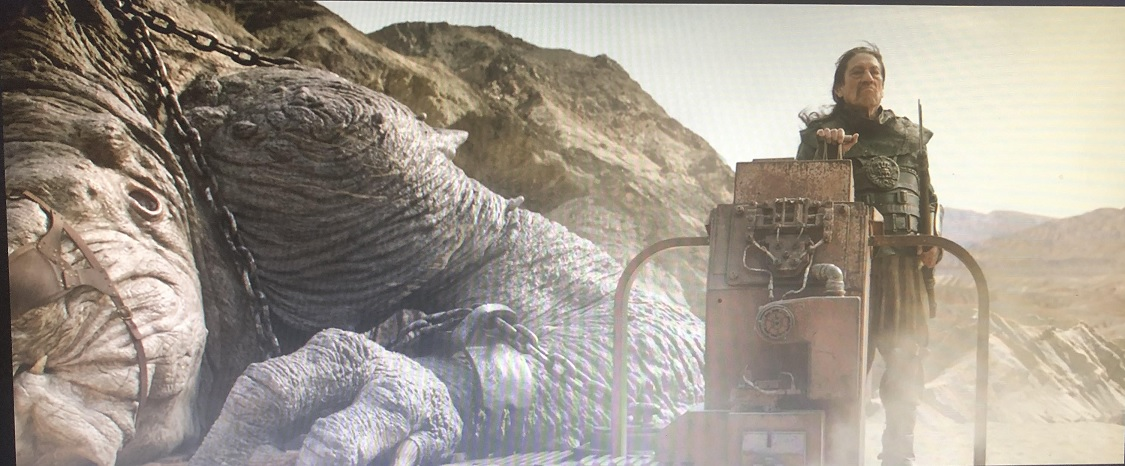
 I hope I haven't forgotten how to do this. I submitted the review to Amazon, but who knows if they will accept it? I titled it "The Mexican Rancor," and included this picture with the review:

From Season 1, Episode 3 of 
"The Book of Boba Fett"

Here's the text of my review:

I received my hardback copy as a gift from my daughter, the Beautifuful Princess Bride (yes, it IS spelled that way). She knows I have been walking down the road my brother Danny describes so vividly for 35 years, which is a bit over half of my life; and, because she knows me so very well, she knew my brother Danny’s story would speak to me.
For some years, I have used e-readers. Thus, I didn’t give the hardback copy of “Trejo” the attention it so richly deserved. I implore you not to repeat my mistake; my brother Danny filters mountains of pain to produce the sweet redemption story found here. It’s worth the sacrifice of foregoing a backlit, searchable text!
Prior to reading the book, I thought my brother Danny was only a bad-ass criminal who had lucked into a bunch of Hollywood suckers who paid him to convert real-life thuggery to the celluloid version, and that was responsible for his seeming transformation. As in the case of all lies, a great deal of truth is there. There are two missing elements, however.
The first is that his transformation preceded his Hollywood experience; it came about when he got sick and tired of being sick and tired. 
My brother Danny was never, from the moment he was born, given an environment free of fear-driven rage and violence, with the only solace coming from alcohol, drugs, sex, and inflicting violence on others. That wasn’t presented as insanity to him; it was simply the way life worked. From an early age, he was actively encouraged to follow that path, by people who took the deepest interest in his well-being. He took those lessons to heart, until the thuggery put him behind bars, and made it near-impossible to even realize that the real bars were those of the soul.
But God.
The second element missing from my earlier image of my brother Danny was that his battle to remain clean and sober was nothing, compared to his battle to recognize and overcome his character defects that prevented him from giving and receiving love.  For long decades, he was tormented by a pathology that prevented him from accepting love from the many women in his life, and he gave back rejection in exchange. 
But God.
I was delighted by the most recent appearance of my brother Danny on screen, in Season 1, Episode 3 of The Book of Boba Fett. After reading the book, I re-watched his scene (starting around 23:40) in which he presents Boba Fett with a rancor, a most horrifying and powerful beast. It hit me that in describing the rancor, he was telling his own story. His last words reveal the depth of healing he himself has been given in real life: “Don’t worry. He’ll be back.” This is THE answer to the fear that drove all of his transgressions, and his confidence in that statement show me that he, too, has learned that those he loves will not abandon him. 
My brother Danny discovered at the deepest level that it is more blessed to give than to receive, and he carries the message of redemption and recovery to those who are still suffering at all times.
He is doing it right now. 

Peace be on your household. 


Wednesday, May 25, 2022

Are Red Flag Laws the Solution to Mass Murder of Children?

 Today, David French, a thinking conservative columnist, lawyer, veteran, and Christian believer, wrote advocating red-flag laws. I hope that the people who frequent my page will read his article before posting comments pointing out the problems with such laws.

However:

What good is a law which (temporarily) removes firearms from someone who presents a threat of violence if there is no effective screening and treatment option? 

The state got out of the mental health business in the 1980s, and in the 1990s insurance companies essentially shut down private by refusing to pay for anything other than brief treatment. 

We are looking at the longer-term consequences of applauding the abandonment of public mental health services, specifically, residential treatment facilities. Instead, we were told that "community mental health" was the way to go. For many, maybe most, that's true. But it's not true for all, and, without mental health beds, those suffering with severe mood and thought disorders can (at best) hope to be arrested. 

If I wanted first-class trauma treatment, I think I'd want to go to Grady Hospital, because they deal with shootings, stabbings, and industrial accidents ALL the time.  They have lots of experience. But today, who has lots of experience in screening mental health patients to determine if admission is necessary? A few, I'm sure; but did the people who screened the Buffalo shooter, or the Parkland shooter have the experience needed to make the right choice? Or was it just that there wasn't any place for them to go?

We WILL pay a price for those suffering from mental health  issues; right now, without intending to do so, we are paying in blood and grief. 

Empty buildings at
the former Georgia Mental Health Institute

There is so much more I want to say. I hope that what I HAVE said has gotten the attention of some.

Peace be on your household.


Friday, August 20, 2021

"Me, Myself, and Bob," by Phil Vischer


In the late 1990s, my family met Phil Vischer and his company, Big Idea, through Veggie Tales, The children’s ministry at our church was putting together a performance, and my youngest son, then about eight years old, had to learn the following line:

“I’m sorry that I scared you when you saw me on TV.”

I’m not sure, but I THINK he was picked to say that line because he has always been the biggest kid in his class, and his role was that of Frankencelery, aka Phil Winklestein of Toledo, Ohio. So: big character should be played by a big kid. 

It did not go to my son’s strengths.

Still, we rehearsed the line over and over, and when the time came for him to pop up and speak, he had a smile on his face. And nobody threw stones.

Next thing you know, we were all marching around the house, singing “God is Bigger than the Boogie Man!” to the dog; and, we were happy with that. We bought the videos, we bought the cassette tapes, and we learned the words to Silly Songs. We even performed one of them at a family reunion. In fact, I adapted “The Water Buffalo Song” to introduce my middle school to the concept of student conflict managers.

“Everybody’s got a peace-keeping crew
To help you when you’re feeling blue,
When you don’t know just what to do
Everybody’s got a peace-keeping crew!”

Time passed, and life went on. My kids sort of aged-out of Veggie Tales videos, but we were always happy when the characters popped up again. When “Jonah” hit the big screen, I was delighted, and we went to see it, but I wasn’t really FOLLOWING what was happening with Big Idea.

And so, I was taken by surprise, when I read a May 2004 article in Christianity Today titled “Running Out of Miracles.” I discovered that Big Idea had over-expanded in developing “Jonah,” and as a result, the company collapsed. The part of the article that stayed with me was the last bit, in which Phil Vischer explains to his son the significance of the collapse of Big Idea. The article ends with the statement of hope “There are a million ways to do it” (tell people about God).  
What I retained, though, perhaps because my youngest son was not much older than Phil’s, was the emotional gut-punch of telling your child that your dream, your creation, was just gone.

And that part of my life crawled off into a cave, and whimpered.

17 years later: one of my oldest friends tells me of this podcast he has discovered, taking very seriously  some terrific challenges facing the Christian church. It turns out that it’s none other than: PHIL VISCHER! I start listening, and quickly become FASCINATED with the combination of humor and deep theology. Eventually, I discover Vischer has written THIS book. So, I get it, and read it, and that whimpering part of me comes out of the cave. 

Yes, the book DOES provide interesting bits about Phil’s background, including his amazing forebears, and how he got in trouble in Bible college. It also describes the way technology and talent combined to permit the birth of Veggie Tales. However, the part of the book that has greatest value, to me personally, AND to anyone who wants to turn creativity into a career, is his detailed analysis of how it all went wrong. In brutally simplest terms, it was a conflict of vision with marketing, and a lack of management over all.

It’s a very poignant story. Like the article in Christianity Today, it ends with hope. HOWEVER! It also ends 15 years ago. That was long before he started the podcast I’ve been immersed in for the past couple of months, and it doesn’t reference a number of creative products he has put forward since then. Not all of them worked! Know this, though: Phil Vischer is still plugging away on one or more of the million ways to tell people about God.

Peace be on your household.

Thursday, August 19, 2021

When Thoughts and Prayers Aren't Enough, by Taylor Schumann

This is an Amazon Associates link; if you click on it, and buy something, I get a few pennies.

Taylor Schumann took advantage of the opportunities that came her way. She had earned a degree in social work, was deeply involved in her church, and was one day away from her bridal shower.

The buckshot that mangled her hand and entered her chest changed those opportunities forever.  The day was Friday, April 12, 2013. It was the last morning she would ever wake up without physical pain.

Her book is not really about the shooting, and it’s not about the shooter.  If you are looking for some methodological police procedural, look elsewhere. True crime junkies will not fawn over this book; neither will those who are rabidly anti- OR pro-gun. That’s because this book presents us with a closely observed experience of a person who saved her own life (literally) by hiding in an unlocked closet, and then was (figuratively) forced to save her life again by fighting her way out of locked closet she was placed in against her will.

My gift-from-God, happily-ever-after trophy wife Vanessa, the elegant, foxy, praying black grandmother of Woodstock, GA, is a trained birth doula. She comes alongside expectant mothers, and guides them through the complications associated with giving birth in the antiseptic, and potentially hostile, conditions found in many hospitals. Time and again, as I was reading Taylor’s story, I wished she had an analogue of a birth doula at her side, to explain to her what was happening, what she could expect, what the outcomes might be, and mostly, to explain her choices to her. Actually, at SOME steps of the process, she had people to fill that role. She commends the police investigators, and representatives of the victim’s assistance program, for guiding her through some of the rough spots in the immediate aftermath. At other times, she was able to rely on family members to help her with procedures and paperwork that were required due to her injuries. 

Those just covered specific points in her recovery, however. Vanessa sits with the expectant mother, all through the process; she attends birthday parties afterward. And over and over, I wished Taylor had a Vanessa to sit with her, providing comfort, support, knowledge and advice; most of all, someone who understood what Taylor was going through.

Behold, I shall hide nothing from you: I own firearms. I am a Life Member of the NRA. Taylor and I are not alike in many ways. However. HOWEVER. However, Taylor’s story touched a part of me that I wasn’t aware existed. It’s not the universe leading up to her shooting that has changed my mind and heart; it’s the universe that exists afterward.

You see, except for the immediate aftermath, Taylor was ignored by too many of the people who meant the most to her. Her background is one that could be described as firearm-friendly, not firearm-hostile. I find myself unable to describe it, other than solidly Southern middle class. People didn’t carry a gun to the dinner table, but there could very well be hunting rifles in a gun cabinet and perhaps a pistol in the drawer of the bedside table. It wasn’t a big part of the lives of her friends and family, but everyone believed in the Second Amendment. 

And because of that, when Taylor got shot, too many of those she cared for simply didn’t know what to do with that. SO, she got ignored. And so, she suffered another loss, in addition to the physical loss of the use of her hand.

That is the figurative closet she was locked into, against her will. 

This book is the story of how she saved her life, a second time. It is also a story in progress.

Taylor offers some action steps, for those who hear her story. Will you understand me if I tell you that there is NO WAY that some of those steps work for me? However, I am compelled to take action to assist those who, like Taylor, had their opportunities limited because someone shot them. I’m open to anything God leads me to do in this respect, but until I get directed in a different direction, I will be donating money to benefit gunshot victims. I’ve already started the process, and will refine it as I get more light.

Peace be on your household.

Friday, July 23, 2021

Book review: "Other Rhodes," by Sarah A. Hoyt


I’m slow. I get there eventually, but I’m slow.

The cover of “Other Rhodes” CLEARLY designates this as “Rhodes 1.” You’d think that I would know that this is first of a series, right? And yet, somewhere after the first half of the novel, I’m doing a frantic-bookworm plea: “Oh, this would make for a WONDERFUL series! I hope she has a series set up! This HAS to be a series!”

Well, duh. It’s first in a series. Therefore, always assuming that the Beautiful-But-Evil Space Princess doesn’t turn her hand to some other endeavor, we have delight ahead.

Delight, that is, for those who enjoy such delicacies as the Hard-Boiled Detective,  Nero Wolfe, Mickey Spillane, Sherlock Holmes, Damon Runyon, and Robert Parker. You know; like that, but different. Because, all that IN S-P-A-A-C-E!!!

A Professor of Literature who read the above paragraph would immediately foam at the mouth, exclaiming “THOSE ARE ALL DIFFERENT! You  can’t lump them into one category!” Well, I just did, and the category was “Written Stuff I Enjoy.” So there.

A silly/dumb/gorgeous secretary. Except she’s NOT silly or dumb (she is gorgeous); except she IS silly and dumb (or, at least ignorant) in the beginning. She’s a hothouse flower, you see. You’ve heard of gilding the lily, meaning that you put needless decoration on something that doesn’t need it? Well, her maiden name is Lilly Gilding. By her own admission, her early education taught her how to dance and look pretty. In that condition, she married Joe Aster (thus acquiring ANOTHER flower name), a private investigator totally unsuitable for a young lady of her status. Her super-wealthy father responded by cutting her off from support, perhaps hoping to bring her to her senses. 

It actually worked, though not in a way Daddy had anticipated, and not in a way Lilly recognized. Forced into the world of work, Lilly became part of Joe’s investigative operation. Silly and dumb people can’t do what she did, and I can only suppose it was because she had never been allowed to overcome challenges that she fails to appreciate all she accomplishes: “merely” a receptionist, she masters typing and accounting, and gets her Investigator license. She becomes an integral part of Joe’s work. All of that, without realizing that she has become far more than ornamental.

That’s the ignorance that is her greatest limitation.

Joe has patterned his practice on a popular series of detective stories. Even their home base/space ship is christened “West 35th Street,” after the locale of the stories. These are presented as immersive experiences (“mersi”) featuring fictional and flawed detective Nick Rhodes and drop-dead-gorgeous partner Stella D’Or. 

Joe loves them; Lilly does not. However, when Joe shows up transformed and incapacitated, the silly/dumb Lilly realizes that the solution lies in the mersi story. 

And she takes appropriate action. Excitement and intrigue ensue. The foundation for a series is laid!

Apropos of nothing, the real West 35th Street in New York is home of the Church of the Incarnation, celebrating the appearance of the Divine in another form. But that is a topic for the Professor of Literature.

Don’t ignore the glorious cover art. It’s almost photo-realism, and would make a GREAT wall poster.

Peace be on your household.


Thursday, June 3, 2021

"We Dare: Semper Paratus "Edited by Jamie Ibson & Chris Kennedy


All of these stories take place after The End Of The World As We Know It (TEOTWAWKI; I think I got that acronym right). No particular cause was stipulated for the writers, so we get a blend: some are from futures already established, such as Chris Woods’ “This Fallen World” universe; while others are brand new disasters. However, fear not; these cloudy worlds all come with some semblance of a silver lining.

THE DAUGHTER, by Chris Kennedy. Set in “This Fallen World.” One of the distinguishing marks of TFW is that the technology existed, prior to the fall, to imprint an entire personality onto/into a subject. While the imprinted subject may need to develop some muscles, all of the reflexes and knowledge that were in the imprint are transferred over. However, only one personality can be dominant at a time. That means that as long as the imprint is in control, the original is (more or less) dormant. The plot, characterization, action of this story are well-developed. However, we are given something else to think about, and we might be thinking about it for a long time: what are the ethics of keeping a subordinate from suffering?

RESPAWN, by Robert E. Hampson. Any right-thinking resident of the South knows that Waffle Houses are rightly the center of culture and goodness, and may very well be the center of the universe. Well, portals, at least; or, they are in this story, even if given an alternative title. When an active playing character gets killed, they are returned to existence in these blessed locations, where there is always a refill for your coffee. Everything else in the universe might vary, though. So be careful.

BOB, FROM LOS ANGELES, by Brent Roeder. Soren Kierkegaard wrote “Purity of heart is to will one thing.” If that is true, then Bob, from Los Angeles, has the purest heart imaginable. Don’t expect him to engage in much idle chatter, but if a job needs to be done? Bob is your man.  

NOR WAR’S QUICK FIRE, by Rob Howell. A person with great wealth arranges to have a small contingent of employees be evacuated to the fledgling colony on Mars, just as war spasms on Earth. It’s amazing how many different perspectives can be held in a group of intelligent people. What’s more amazing is that some perspectives are subject to change.

WHY 2K, by Jon R. Osborne. Now, THIS is the apocalypse we were promised! What if the prep to eliminate the fallout from using only two digits to record the year hadn’t worked, and all the doom and gloom about Y2K had been realized? That’s what THIS story is about; it’s about time!

THE FALLOW FIELDS, PART I, by Jason Cordova, and THE FALLOW FIELDS, PART II, by Christopher L Smith. Confession: I was so caught up in the story, that I kept reading, and didn’t realize until NOW that parts I & II were written by different authors. I suppose an accomplished reviewer would notice the stylistic changes, and have something clever to say about that, but THIS reviewer was simply engrossed in the adventure. 
I don’t know how much chaos reigned in the land that became the Soviet Union during consolidation after the Bolshevik revolution, but I do know that the US military was involved in two separate campaigns, North Russia and Siberia, in the post WWI period. To that chaos, add a zombie apocalypse, and then follow the crew of a tank as they fight their way through the worst that can come at them.

THE RESERVOIR, by Kevin Fritz Fotovich. First Contact didn’t go so well, and big rocks got dropped on our heads. It didn’t take much to disrupt nearly everything. Still, a determined people can rebuild, particularly when the former enemies can lend help. Other people are determined as well, though.

WARLORD, by Christopher Woods. Books have been written about the exploits of Matthew Kade, deservedly so. The imprinting of personalities went somewhat wrong with him, in the same sense that the Atlantic Ocean is somewhat damp. Somehow, he has managed to find a way that all of his many personalities can get along. He really hates people who keep slaves. And he is always on the lookout for new talent.

TEN BREATHS, by Marisa Wolf. Don’t think that magic will prevent the world from ending. It will just end in a different way, with different options. Still, resolute people can fight back. In this universe, the darkness is on the way, and the people must prepare to fight, and to endure.

MOMENTS, by Kevin Ikenberry. It’s bad enough that the world ends. However, when the world ends just after the worst night of your life, you don’t get an opportunity to make up for a momentary failure. And that turns what SHOULD be a moment, into an eternity.  Maybe another moment will come; but don’t bet on it. Just try to keep doing the next right thing.

YOU HAVE TO GO OUT, by Philip Wohlrab. Here’s the deal: in the Army, you can catch your breath during peacetime. Yes, there is still training, and it is demanding, and people can die in accidents, but at least, in peacetime, nobody is actually shooting at you. So, there’s that. HOWEVER, in the Cast Guard, the enemy is the sea, and the sea NEVER is willing to sign a peace treaty. And it doesn’t make any difference to the Coast Guard if people are shooting at you or not; they still have to do their job, and that means going out.

EIGHT OUNCES A DAY, by Kevin Steverson. In the aftermath of an engineered extinction event, protein is hard to come by; the terrorists did their sums wrong, and killed the animals as well as the people. Still, some survive, including a janitor at Kennesaw State University. Too bad their mascot is an owl; a turkey would have been more convenient.

WRAITH, by Marie Whittaker. Fairly soon after the wraiths appear and start eating people, June Bug discovers that salt will kill them dead. It’s not until much later that things get really weird.

DUST TO DUST, by Jamie Ibson. The most intriguing aspect (among the many delights) of this story is that the reason for the apocalypse is not revealed, until it shows up as a part of the Final Answer. Until then, we start with a near-standard tale of the Old West, with a pleasing young lady from Back East arriving to take ownership of the family estate.  However, she is no tinhorn, not a shrinking violet who must rely on the protection of strong-but-silent, etc. From Western, we shift to a mystery, complete with strangers acting strange, and clues to be found. It’s really a great story, and one that could easily fill the pages of a novel.

The collection is packed solid with great stories, and it’s worth multiple re-reads.

Peace be on your household.


Saturday, May 29, 2021

Doctor Inferno, by Pam Uphoff


I would have gotten this book, just because it’s written by one of the Masters of Prolificity, Pam Uphoff. Once you start reading her work, you will never finish (at least, not as long as you are trying to do other things with your life); but what a great way to go!

However, there was another reason for picking this volume, and that is that the person on the front cover looks A LOT like me, with some few differences; my hairline hasn’t receded that far back, yet. I was delighted to find that this represents a super-villain, and more so to discover that he’s about three hundred years older than I. So, I have a while to work on the hairline.

Alas, William N. Furnace (Dr. Inferno) and I appear to have at least one other thing in common: we forget things. He forgets what senior activities he has signed up for; I forget to review books I’ve gotten. This particular item was picked up on March 11; today is May 29. 

Sorry, Pam.

He’s long since retired, and been forgotten by the world. That’s what permits him to live undisturbed in a senior facility, close enough to the bright lights of Las Vegas to permit monthly field trips. Undisturbed, despite the fact that one of his fellow residents is a former agent who had pursued him during his days of active mischief. Time has healed those wounds, however, and now they have a bond formed by the fact that they are both inactive, due to being more than three centuries old. They expect that even their advanced, and manipulated, DNA will give out eventually, though, as it has already shown signs of doing.

But, don’t touch that dial! A comeback awaits!

A combination of irascibility, luck, and general refusal to accept fate without fighting back puts our aged ex-villain back into action. Backed with resources accumulated by his long-active AI, Dr Inferno emerges, just in time to threaten/save the world, one more time.

Uphoff’s ability to make you feel the characters she produces is enough to cause one to be just a bit suspicious. Does she actually KNOW a near-senescent super-villain? Is that why she is able to make this character come to life so thoroughly?

Alas. I fear that it’s merely a case of her being able to write characters that we want to be, ourselves. Is there anyone who WOULDN’T like to rise above the wheelchair and adult diapers, and shake the world to its’ foundations again? 

Maybe it’s just because the cover image and I resemble each other, but I think not. I would have liked to read this when I was 12 years old. I was, of course, a confirmed FAN by that time. And, while the technology referenced in the story would have been far advanced for 1965, the true nature of the adventure lies in the determination of the characters to Get The Job Done. And, as long as she is writing about that, not private relationships with super-villains are necessary.

I’m not ruling them out, though. She does, after all, live in Texas.

Peace be on your household.