Showing posts with label Book Review. Show all posts

Friday, August 20, 2021

"Me, Myself, and Bob," by Phil Vischer


In the late 1990s, my family met Phil Vischer and his company, Big Idea, through Veggie Tales, The children’s ministry at our church was putting together a performance, and my youngest son, then about eight years old, had to learn the following line:

“I’m sorry that I scared you when you saw me on TV.”

I’m not sure, but I THINK he was picked to say that line because he has always been the biggest kid in his class, and his role was that of Frankencelery, aka Phil Winklestein of Toledo, Ohio. So: big character should be played by a big kid. 

It did not go to my son’s strengths.

Still, we rehearsed the line over and over, and when the time came for him to pop up and speak, he had a smile on his face. And nobody threw stones.

Next thing you know, we were all marching around the house, singing “God is Bigger than the Boogie Man!” to the dog; and, we were happy with that. We bought the videos, we bought the cassette tapes, and we learned the words to Silly Songs. We even performed one of them at a family reunion. In fact, I adapted “The Water Buffalo Song” to introduce my middle school to the concept of student conflict managers.

“Everybody’s got a peace-keeping crew
To help you when you’re feeling blue,
When you don’t know just what to do
Everybody’s got a peace-keeping crew!”

Time passed, and life went on. My kids sort of aged-out of Veggie Tales videos, but we were always happy when the characters popped up again. When “Jonah” hit the big screen, I was delighted, and we went to see it, but I wasn’t really FOLLOWING what was happening with Big Idea.

And so, I was taken by surprise, when I read a May 2004 article in Christianity Today titled “Running Out of Miracles.” I discovered that Big Idea had over-expanded in developing “Jonah,” and as a result, the company collapsed. The part of the article that stayed with me was the last bit, in which Phil Vischer explains to his son the significance of the collapse of Big Idea. The article ends with the statement of hope “There are a million ways to do it” (tell people about God).  
What I retained, though, perhaps because my youngest son was not much older than Phil’s, was the emotional gut-punch of telling your child that your dream, your creation, was just gone.

And that part of my life crawled off into a cave, and whimpered.

17 years later: one of my oldest friends tells me of this podcast he has discovered, taking very seriously  some terrific challenges facing the Christian church. It turns out that it’s none other than: PHIL VISCHER! I start listening, and quickly become FASCINATED with the combination of humor and deep theology. Eventually, I discover Vischer has written THIS book. So, I get it, and read it, and that whimpering part of me comes out of the cave. 

Yes, the book DOES provide interesting bits about Phil’s background, including his amazing forebears, and how he got in trouble in Bible college. It also describes the way technology and talent combined to permit the birth of Veggie Tales. However, the part of the book that has greatest value, to me personally, AND to anyone who wants to turn creativity into a career, is his detailed analysis of how it all went wrong. In brutally simplest terms, it was a conflict of vision with marketing, and a lack of management over all.

It’s a very poignant story. Like the article in Christianity Today, it ends with hope. HOWEVER! It also ends 15 years ago. That was long before he started the podcast I’ve been immersed in for the past couple of months, and it doesn’t reference a number of creative products he has put forward since then. Not all of them worked! Know this, though: Phil Vischer is still plugging away on one or more of the million ways to tell people about God.

Peace be on your household.

Thursday, August 19, 2021

When Thoughts and Prayers Aren't Enough, by Taylor Schumann

This is an Amazon Associates link; if you click on it, and buy something, I get a few pennies.

Taylor Schumann took advantage of the opportunities that came her way. She had earned a degree in social work, was deeply involved in her church, and was one day away from her bridal shower.

The buckshot that mangled her hand and entered her chest changed those opportunities forever.  The day was Friday, April 12, 2013. It was the last morning she would ever wake up without physical pain.

Her book is not really about the shooting, and it’s not about the shooter.  If you are looking for some methodological police procedural, look elsewhere. True crime junkies will not fawn over this book; neither will those who are rabidly anti- OR pro-gun. That’s because this book presents us with a closely observed experience of a person who saved her own life (literally) by hiding in an unlocked closet, and then was (figuratively) forced to save her life again by fighting her way out of locked closet she was placed in against her will.

My gift-from-God, happily-ever-after trophy wife Vanessa, the elegant, foxy, praying black grandmother of Woodstock, GA, is a trained birth doula. She comes alongside expectant mothers, and guides them through the complications associated with giving birth in the antiseptic, and potentially hostile, conditions found in many hospitals. Time and again, as I was reading Taylor’s story, I wished she had an analogue of a birth doula at her side, to explain to her what was happening, what she could expect, what the outcomes might be, and mostly, to explain her choices to her. Actually, at SOME steps of the process, she had people to fill that role. She commends the police investigators, and representatives of the victim’s assistance program, for guiding her through some of the rough spots in the immediate aftermath. At other times, she was able to rely on family members to help her with procedures and paperwork that were required due to her injuries. 

Those just covered specific points in her recovery, however. Vanessa sits with the expectant mother, all through the process; she attends birthday parties afterward. And over and over, I wished Taylor had a Vanessa to sit with her, providing comfort, support, knowledge and advice; most of all, someone who understood what Taylor was going through.

Behold, I shall hide nothing from you: I own firearms. I am a Life Member of the NRA. Taylor and I are not alike in many ways. However. HOWEVER. However, Taylor’s story touched a part of me that I wasn’t aware existed. It’s not the universe leading up to her shooting that has changed my mind and heart; it’s the universe that exists afterward.

You see, except for the immediate aftermath, Taylor was ignored by too many of the people who meant the most to her. Her background is one that could be described as firearm-friendly, not firearm-hostile. I find myself unable to describe it, other than solidly Southern middle class. People didn’t carry a gun to the dinner table, but there could very well be hunting rifles in a gun cabinet and perhaps a pistol in the drawer of the bedside table. It wasn’t a big part of the lives of her friends and family, but everyone believed in the Second Amendment. 

And because of that, when Taylor got shot, too many of those she cared for simply didn’t know what to do with that. SO, she got ignored. And so, she suffered another loss, in addition to the physical loss of the use of her hand.

That is the figurative closet she was locked into, against her will. 

This book is the story of how she saved her life, a second time. It is also a story in progress.

Taylor offers some action steps, for those who hear her story. Will you understand me if I tell you that there is NO WAY that some of those steps work for me? However, I am compelled to take action to assist those who, like Taylor, had their opportunities limited because someone shot them. I’m open to anything God leads me to do in this respect, but until I get directed in a different direction, I will be donating money to benefit gunshot victims. I’ve already started the process, and will refine it as I get more light.

Peace be on your household.

Friday, July 23, 2021

Book review: "Other Rhodes," by Sarah A. Hoyt


I’m slow. I get there eventually, but I’m slow.

The cover of “Other Rhodes” CLEARLY designates this as “Rhodes 1.” You’d think that I would know that this is first of a series, right? And yet, somewhere after the first half of the novel, I’m doing a frantic-bookworm plea: “Oh, this would make for a WONDERFUL series! I hope she has a series set up! This HAS to be a series!”

Well, duh. It’s first in a series. Therefore, always assuming that the Beautiful-But-Evil Space Princess doesn’t turn her hand to some other endeavor, we have delight ahead.

Delight, that is, for those who enjoy such delicacies as the Hard-Boiled Detective,  Nero Wolfe, Mickey Spillane, Sherlock Holmes, Damon Runyon, and Robert Parker. You know; like that, but different. Because, all that IN S-P-A-A-C-E!!!

A Professor of Literature who read the above paragraph would immediately foam at the mouth, exclaiming “THOSE ARE ALL DIFFERENT! You  can’t lump them into one category!” Well, I just did, and the category was “Written Stuff I Enjoy.” So there.

A silly/dumb/gorgeous secretary. Except she’s NOT silly or dumb (she is gorgeous); except she IS silly and dumb (or, at least ignorant) in the beginning. She’s a hothouse flower, you see. You’ve heard of gilding the lily, meaning that you put needless decoration on something that doesn’t need it? Well, her maiden name is Lilly Gilding. By her own admission, her early education taught her how to dance and look pretty. In that condition, she married Joe Aster (thus acquiring ANOTHER flower name), a private investigator totally unsuitable for a young lady of her status. Her super-wealthy father responded by cutting her off from support, perhaps hoping to bring her to her senses. 

It actually worked, though not in a way Daddy had anticipated, and not in a way Lilly recognized. Forced into the world of work, Lilly became part of Joe’s investigative operation. Silly and dumb people can’t do what she did, and I can only suppose it was because she had never been allowed to overcome challenges that she fails to appreciate all she accomplishes: “merely” a receptionist, she masters typing and accounting, and gets her Investigator license. She becomes an integral part of Joe’s work. All of that, without realizing that she has become far more than ornamental.

That’s the ignorance that is her greatest limitation.

Joe has patterned his practice on a popular series of detective stories. Even their home base/space ship is christened “West 35th Street,” after the locale of the stories. These are presented as immersive experiences (“mersi”) featuring fictional and flawed detective Nick Rhodes and drop-dead-gorgeous partner Stella D’Or. 

Joe loves them; Lilly does not. However, when Joe shows up transformed and incapacitated, the silly/dumb Lilly realizes that the solution lies in the mersi story. 

And she takes appropriate action. Excitement and intrigue ensue. The foundation for a series is laid!

Apropos of nothing, the real West 35th Street in New York is home of the Church of the Incarnation, celebrating the appearance of the Divine in another form. But that is a topic for the Professor of Literature.

Don’t ignore the glorious cover art. It’s almost photo-realism, and would make a GREAT wall poster.

Peace be on your household.


Thursday, June 3, 2021

"We Dare: Semper Paratus "Edited by Jamie Ibson & Chris Kennedy


All of these stories take place after The End Of The World As We Know It (TEOTWAWKI; I think I got that acronym right). No particular cause was stipulated for the writers, so we get a blend: some are from futures already established, such as Chris Woods’ “This Fallen World” universe; while others are brand new disasters. However, fear not; these cloudy worlds all come with some semblance of a silver lining.

THE DAUGHTER, by Chris Kennedy. Set in “This Fallen World.” One of the distinguishing marks of TFW is that the technology existed, prior to the fall, to imprint an entire personality onto/into a subject. While the imprinted subject may need to develop some muscles, all of the reflexes and knowledge that were in the imprint are transferred over. However, only one personality can be dominant at a time. That means that as long as the imprint is in control, the original is (more or less) dormant. The plot, characterization, action of this story are well-developed. However, we are given something else to think about, and we might be thinking about it for a long time: what are the ethics of keeping a subordinate from suffering?

RESPAWN, by Robert E. Hampson. Any right-thinking resident of the South knows that Waffle Houses are rightly the center of culture and goodness, and may very well be the center of the universe. Well, portals, at least; or, they are in this story, even if given an alternative title. When an active playing character gets killed, they are returned to existence in these blessed locations, where there is always a refill for your coffee. Everything else in the universe might vary, though. So be careful.

BOB, FROM LOS ANGELES, by Brent Roeder. Soren Kierkegaard wrote “Purity of heart is to will one thing.” If that is true, then Bob, from Los Angeles, has the purest heart imaginable. Don’t expect him to engage in much idle chatter, but if a job needs to be done? Bob is your man.  

NOR WAR’S QUICK FIRE, by Rob Howell. A person with great wealth arranges to have a small contingent of employees be evacuated to the fledgling colony on Mars, just as war spasms on Earth. It’s amazing how many different perspectives can be held in a group of intelligent people. What’s more amazing is that some perspectives are subject to change.

WHY 2K, by Jon R. Osborne. Now, THIS is the apocalypse we were promised! What if the prep to eliminate the fallout from using only two digits to record the year hadn’t worked, and all the doom and gloom about Y2K had been realized? That’s what THIS story is about; it’s about time!

THE FALLOW FIELDS, PART I, by Jason Cordova, and THE FALLOW FIELDS, PART II, by Christopher L Smith. Confession: I was so caught up in the story, that I kept reading, and didn’t realize until NOW that parts I & II were written by different authors. I suppose an accomplished reviewer would notice the stylistic changes, and have something clever to say about that, but THIS reviewer was simply engrossed in the adventure. 
I don’t know how much chaos reigned in the land that became the Soviet Union during consolidation after the Bolshevik revolution, but I do know that the US military was involved in two separate campaigns, North Russia and Siberia, in the post WWI period. To that chaos, add a zombie apocalypse, and then follow the crew of a tank as they fight their way through the worst that can come at them.

THE RESERVOIR, by Kevin Fritz Fotovich. First Contact didn’t go so well, and big rocks got dropped on our heads. It didn’t take much to disrupt nearly everything. Still, a determined people can rebuild, particularly when the former enemies can lend help. Other people are determined as well, though.

WARLORD, by Christopher Woods. Books have been written about the exploits of Matthew Kade, deservedly so. The imprinting of personalities went somewhat wrong with him, in the same sense that the Atlantic Ocean is somewhat damp. Somehow, he has managed to find a way that all of his many personalities can get along. He really hates people who keep slaves. And he is always on the lookout for new talent.

TEN BREATHS, by Marisa Wolf. Don’t think that magic will prevent the world from ending. It will just end in a different way, with different options. Still, resolute people can fight back. In this universe, the darkness is on the way, and the people must prepare to fight, and to endure.

MOMENTS, by Kevin Ikenberry. It’s bad enough that the world ends. However, when the world ends just after the worst night of your life, you don’t get an opportunity to make up for a momentary failure. And that turns what SHOULD be a moment, into an eternity.  Maybe another moment will come; but don’t bet on it. Just try to keep doing the next right thing.

YOU HAVE TO GO OUT, by Philip Wohlrab. Here’s the deal: in the Army, you can catch your breath during peacetime. Yes, there is still training, and it is demanding, and people can die in accidents, but at least, in peacetime, nobody is actually shooting at you. So, there’s that. HOWEVER, in the Cast Guard, the enemy is the sea, and the sea NEVER is willing to sign a peace treaty. And it doesn’t make any difference to the Coast Guard if people are shooting at you or not; they still have to do their job, and that means going out.

EIGHT OUNCES A DAY, by Kevin Steverson. In the aftermath of an engineered extinction event, protein is hard to come by; the terrorists did their sums wrong, and killed the animals as well as the people. Still, some survive, including a janitor at Kennesaw State University. Too bad their mascot is an owl; a turkey would have been more convenient.

WRAITH, by Marie Whittaker. Fairly soon after the wraiths appear and start eating people, June Bug discovers that salt will kill them dead. It’s not until much later that things get really weird.

DUST TO DUST, by Jamie Ibson. The most intriguing aspect (among the many delights) of this story is that the reason for the apocalypse is not revealed, until it shows up as a part of the Final Answer. Until then, we start with a near-standard tale of the Old West, with a pleasing young lady from Back East arriving to take ownership of the family estate.  However, she is no tinhorn, not a shrinking violet who must rely on the protection of strong-but-silent, etc. From Western, we shift to a mystery, complete with strangers acting strange, and clues to be found. It’s really a great story, and one that could easily fill the pages of a novel.

The collection is packed solid with great stories, and it’s worth multiple re-reads.

Peace be on your household.


Saturday, May 29, 2021

Doctor Inferno, by Pam Uphoff


I would have gotten this book, just because it’s written by one of the Masters of Prolificity, Pam Uphoff. Once you start reading her work, you will never finish (at least, not as long as you are trying to do other things with your life); but what a great way to go!

However, there was another reason for picking this volume, and that is that the person on the front cover looks A LOT like me, with some few differences; my hairline hasn’t receded that far back, yet. I was delighted to find that this represents a super-villain, and more so to discover that he’s about three hundred years older than I. So, I have a while to work on the hairline.

Alas, William N. Furnace (Dr. Inferno) and I appear to have at least one other thing in common: we forget things. He forgets what senior activities he has signed up for; I forget to review books I’ve gotten. This particular item was picked up on March 11; today is May 29. 

Sorry, Pam.

He’s long since retired, and been forgotten by the world. That’s what permits him to live undisturbed in a senior facility, close enough to the bright lights of Las Vegas to permit monthly field trips. Undisturbed, despite the fact that one of his fellow residents is a former agent who had pursued him during his days of active mischief. Time has healed those wounds, however, and now they have a bond formed by the fact that they are both inactive, due to being more than three centuries old. They expect that even their advanced, and manipulated, DNA will give out eventually, though, as it has already shown signs of doing.

But, don’t touch that dial! A comeback awaits!

A combination of irascibility, luck, and general refusal to accept fate without fighting back puts our aged ex-villain back into action. Backed with resources accumulated by his long-active AI, Dr Inferno emerges, just in time to threaten/save the world, one more time.

Uphoff’s ability to make you feel the characters she produces is enough to cause one to be just a bit suspicious. Does she actually KNOW a near-senescent super-villain? Is that why she is able to make this character come to life so thoroughly?

Alas. I fear that it’s merely a case of her being able to write characters that we want to be, ourselves. Is there anyone who WOULDN’T like to rise above the wheelchair and adult diapers, and shake the world to its’ foundations again? 

Maybe it’s just because the cover image and I resemble each other, but I think not. I would have liked to read this when I was 12 years old. I was, of course, a confirmed FAN by that time. And, while the technology referenced in the story would have been far advanced for 1965, the true nature of the adventure lies in the determination of the characters to Get The Job Done. And, as long as she is writing about that, not private relationships with super-villains are necessary.

I’m not ruling them out, though. She does, after all, live in Texas.

Peace be on your household.

Thursday, May 27, 2021

"Night Mage" (Academic Magic Book 2), by Becky R. Jones


The “Academic Magic” series, of which this is the second installment, delightfully mixes the savagery of battles in the halls of higher education with the more civilized conflicts found in the world of magic. An evil mage will merely seek your death, and subordination of the world to their will; the wicked academic, on the other hand, will seek to sabotage your research, have you assigned to a windowless cubicle without access to a copier, and try to make you grovel in order to obtain the golden apple that is TENURE. There truly can be no question as to where the greater peril will be found.

The team which bonded to prevent a demon from destroying the Philadelphia area in the first book has returned, and a few characters are added in the course of the story. For the opposing team, casualties attendant upon their loss have reduced their number, and the influence those that remain are able to bring to bear is significantly reduced.  Dr. Zoe O’Brien, a recent addition to the history faculty and our protagonist, has the vain hope that this will bring a period of peace and tranquility to the campus in general, and her life in particular. Alas, Nature abhors a vacuum, and the depleted forces of the plotters are supplemented by new hires and new powers.

If that were not enough, Zoe’s mentor in things academic as well as magical has been tapped to cover certain administrative tasks for the college, previously managed by one of the vanquished. Thus, he has essentially abandoned his role as her trainer, in favor of meeting the demands of his new position. 

On the other hand, she has cats; cats who can not only talk to humans, but also communicate with other animals (the Watchers) who are sensitive to magical influences. As long as she meets their demands for food and cuddles, they will provide her with the support they think she needs to be successful. The operative term, as anyone who is a servant of cats will understand, is that the advice will be provided according to the CAT’S schedule, not the human’s.

The new crisis is revealed when a previously undiscovered source of magical influence, in the form of ley lines, is reported to Zoe by a Watcher.

As she is a quite recent initiate to the world of magic, and her own powers, she has no way of evaluating the significance or impact of the discovery. Therefore, at first she doesn’t really know whether the message the Watcher has brought her is cause for great alarm, or not, although she suspects the former. Her confusion is compounded by frustrations with the way the experienced magic users are able to pass along the benefits of their wisdom. 

As the main plot moves along, little threads are planted that will (surely) have future payoffs. The powers of student Declan, his relationship with his djinn father, and mixed messages with his academic and magical advisor suggest development at some later date. In addition, Zoe is able to break out some information from her mother about her own parentage, and the bizarre behavior of her absent father. A third point that does directly affect the main story line is the revelation that not all magical agents can be said to be firmly in either camp, enemy or ally. 

And always remember: food service on campus usually provides dismal meals, but they DO make a good burger. 

Peace be on your household.

Wednesday, May 26, 2021

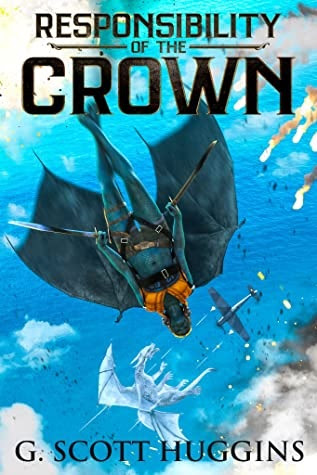
"Responsibility of the Crown," by G. Scott Huggins


 I have read a lot of  Scott Huggins’ work over the years, with delight. This was not one of those experiences.

On a world dominated by a great ocean, three different cultures are brought into conflict: The Consortium, a technologically advanced, expansionist civilization, with both land and sea power; the Grove, a merchant nation with massive trading ships, that journey for decades between stops at the home port; and, Evenmarch, which blends dragon and human citizens with reliance on supernatural forces. These are not the only forces at play, but they form the background  against which the characters play out their own drama.

I found two bizarrely disruptive changes from what I have come to expect of this author: first, there are huge gaps in the narrative; second, the protagonist has an irritatingly lumpy progression in her character arc.

The first gap in the narrative comes at the very beginning. Without ANY preparation, we are tossed into an action scene involving Responsibility and Zhad. We are clued in to the fact that Zhad is blind, by the statement that his eyes are white, and his demand that Responsibility tell him what she sees, but we are given NOTHING to tell us about who, or what, or even where Responsibility is, or the significance of her name.  In the “Acknowledgments” section, the author mentions two prior works involving the character, and perhaps all the necessary back-story is contained there. However, none of that was available to me, and I had to collect the history in minute amounts as it was doled out in the narrative. Had this been an author I was not familiar with, or less favorably inclined toward, I would not have bothered. 

There is a similar gap, although not as severe, in the narrative between chapters 7 and 8. At the end of Chapter 7, Responsibility, now known by her true name of Azriyqam, has just faced a death duel, and has been given significant instruction on  aspects of loyalty and unity. In the very next page, with no transition given at all, we read that she is drowning, followed by a confusing narrative about her instruction in the supernatural arts. I found this to be utterly disorienting; it took me entirely out of the story.

The second significant glitch I encountered was the  inconsistent progress that the protagonist makes during the story. Admittedly, there is much she has to adjust to;  initially, she is a much abused and neglected prisoner, always fearing for her life. Very early in the book, however, she discovers that she is the daughter of the ruler of a powerful kingdom.  The whole of the book deals with her spiritual journey to accept and emerge into her new role. 

However, she is both poorly instructed, in some cases, and then often resistant to what instruction she is given. For example, we learn that she is unable to to pronounce certain phrases of power correctly, as long as she clings to her learned accent. However, if she intentionally mimics the speech of one of her antagonistic characters, her pronunciation is perfect. Despite learning this trick, however, she refuses to implement it.
She seems to shift back and forth, from acceptance to rejection, at random. 
Her stubborn refusal to accept the need to adapt is mirrored perfectly in another character, who is forced by circumstances to become an ally. In her case, though, she has her intransigent behavior stuffed into her face:

“Are you going to keep underestimating us, Captain? Or will you consider that you may have something to learn?” (Huggins, G. Scott. Responsibility of the Crown . New Mythology Press. Kindle Edition.)

And, who is the wiser person who forces this realization? None other than Responsibility/Azriyqam. So, if she preach it, why can’t she live it out?

I really liked the culture clashes possible with the three distinct civilizations. The great world-spanning oceans might be exactly what permits each grouping to go its’ own way, with civilizations based on water at a technological disadvantage to those with access to mineral resources on land. The story of the Lost Princess/Prince is a good one, and can be enjoyed in many permutations. I also appreciate the various aspects of sufficiently advanced technology being indistinguishable from magic being used in the story; at one point, radio is explained by one character to another as sorcery, because the tech is too confusing. 

Although much of the main storyline is resolved, there are many threads that can be followed in the future. I hope that in those theoretical future volumes, the author will provide the reader with enough history to prevent the disorientation that I experienced. I certainly remain a fan of his work, and hope to see more on the way.


Peace be on your household


Monday, May 24, 2021

"When Valor Must Hold," Book One, Rob Howell, editor

(Amazon Associates link)

Sigh. Another anthology. These are almost always my favorite things to read, but my least favorite things to review.
I love to read them, because they were the first form I was able to enjoy, once I discovered my passion for reading. Being a bookworm with ADD meant that grabbing a big thick chapter book just wasn’t in the cards; but short stories? Yes, those kept my attention quite nicely. And today, sometimes my need for escape is far better met a small bite at a time.
Reviewing them, on the other hand, is a massive undertaking. Each author has compacted an experience into a very small package, and my job is to share that with the reading public. If it’s a novel I’m reviewing, that’s one job; in this anthology, it’s fourteen jobs. To that, add the fact that SOME short stories turn on a small plot twist, or a pun, even, and that I must NOT give that away because SPOILER….and, it’s tough.
Sigh.
Yet, my valor must hold; I must do the job I am called to do. So, let us gird up our loins, and dive into the stories. The monsters await!

Darkness Before the Dawn by Christopher Woods. Things haven’t worked out for Zaro. He has an affinity for each of the elements of Earth, Air, Fire, and Water, but none of them selected him for training. So, he was left without a career, and separated from his true love, who was bound to Water. Rather than give up, though, he sets his hand to do what he can; and he does his duty, with each new day.

The Game’s Afoot by Christopher G. Nuttall. The people at the top do this and that, and believe that their whims rule reality. It’s always left up to the grunts to get the job done, though. 

The Ogre’s Brownies by RJ Ladon. Dogumrik is a brownie warrior, fierce and brave; but: tiny. The measure of the heart is far more than stature, though.

Dust in the Mouth by William Joseph Roberts. Draven is independent, before he is anything else. Even so, he willingly pledges his service to travelers he meets in the forest. But there are more dangers than sword and beasts to overcome.

Hanging by a Thread by Benjamin Tyler Smith. What a strange place to set a story! Some folks are dead, though still moving around; others are maybe not. But regardless of their status, it seems that without good policing, the mighty will ever persecute the weak.

Shard’s Fortress by Dexter Herron. This anthology contains 82 f-bombs, by Kindle count. 79 of those are contained in this selection. Is there a story, in addition? Possibly, and that’s a shame, because anything worthwhile is lost in noise.  I gave up, in disgust, after the third or fourth page. I don’t think it’s funny, and I really don’t know why someone with the authority to do so didn’t point out that 79 f-bombs gets tiresome.

Horse’s Heart by Sarah A. Hoyt. When it looks like all is lost, a myth turns out to be true. The tale of multiple heroes, but mostly of one who conquered his own death.

Island of Bones by William Alan Webb. The magicians hitch a ride with the smugglers, and snark at each other; the dialogue is worth the price of admission. Finding faithfulness in the treacherous is also quite pleasant, but I don’t think I understand what happened at the end.

Goddess’s Tears by Cedar Sanderson. Strip away the magnificent language, and the adventure, and you have the story of an abused and neglected woman who has had enough. Because she faces supernatural opposition, she has supernatural support; it’s her determination that makes liberation possible, though, and there is nothing supernatural about that. Magnificent, but not supernatural.

Hold the Line by Kevin Steverson and Tyler Ackerman. This is the story of the scouts. Circumstances deprive them of their role, but they report for duty anyway, and do what is needed.

What’s in a Name by Rob Howell. The protagonist begins the story disoriented, and I joined him in that; I didn’t have any idea WHAT was really going on for quite some time, which isn’t something I enjoy. It turns out to be a tale of conflicting loyalties.

The Errand by Jon R. Osborne. Vikings are jerks, and Vikings with magic are REALLY hard to kill. Even a ferocious Irish archer can use some magical help, from time to time, in order to fight back.

No Trade for Nice Guys by D.J. Butler. I’m not familiar with Indrajit and Fix, but they seem like a lovely pair of sell-swords. They have a way of making things work out, even if they aren’t playing with a full deck.

Fistful of Silver by Quincy J. Allen. Rellen is a sort of bounty hunter, or roving problem-solver. Magic is nicely limited in application in this story, by factors we can understand: if we haven’t LEARNED a language, we can’t read it. Getting to the root of the problem requires some serious detective work.

I found some of the stories to be excellent, and this despite the fact that fantasy really is NOT my cup of tea. Of the rest, all, with the notable exception of Shard's Fortress, were quite palatable, and worth the read. 

Peace be on your household.

Friday, May 21, 2021

"Jaguar Rising," by Amanda S. Green


(an Associates link)

The first book in this series, Nocturnal Origins, was one of the first books I reviewed when I started out in 2014. I blush now, when I admit that I wrote the review with my tongue so firmly placed in my cheek that my ear was slightly bruised. At the time,  I was a bit put off by message-fiction, in which all of the value seemed to be related to whether some social or political agenda was promoted, and good story-telling was ignored.  As an act of rebellion, I decided to write the review as if I were one of the worst of the message-fiction lovers, and had missed the point, utterly. The title of my review on Amazon was “A blisteringly erotic LGBT allegory.”

I blush, again.

If my count is correct, this is the tenth installment in the story of Mackenzie Santos, who started her story as a cop, only to have complications added over the past seven years (or so) of her life in literature. Thus we have a significant problem for the author who writes a series:

How do you address the disorientation of a reader who enters the world, somewhere other than at the beginning? And, how do you do that, without boring the reader who has been following the story all along?

Without detailing the alternatives, other than saying that failure to provide SOME mechanism to bring the initiate up to speed is a BAD choice, I think the method Amanda Green chose in this volume is magnificent. She incorporated most, if not all, of the necessary background into the narrative. Thus, as we see Captain Santos preparing for a new job, we are also given the history of the job she is leaving behind. Her relationships with friends and family are revealed, in the course of the discussion of who will attend which event, and which child needs a snack, and who will provide it.

A straight data dump would likely have been indigestible to the novice, and a waste of space for the committed fan of the story. Furthermore, the transition from background to current events would have been clunky; with this treatment, I found the transition to be perfectly seamless.  

I’m going to have to give part of my applause to the craftsmanship of the writing, and another part to what HAS to be some great planning of the story arc. Knowing what is going to happen in the life of the character isn’t always possible, I’ve learned, but it surely does make for good beginnings and endings to stories.

There is no guarantee that the principal characters in these stories are going to emerge unscathed, or even alive. After all, Santos herself dies in the first installment. However, WHATEVER befalls them is integral to the story; they aren’t killed off just for the sheer bloody-mindedness of it. So, be prepared to have some shocks, as you start your read. Green does NOT hamstring the villains, and in some cases, they accomplish their evil plans.

And those evil plans initiate RAPIDLY. Before the close of the second chapter, the action commences. I really wouldn’t call the book “action-packed,” as it isn’t one exploding spaceship/car chase after another. However, it IS story-packed, with no wasted narrative, and if there are any rabbit trails, I didn’t notice them.

The complications added to Santos’ life over the years are present in the storyline; we see her in her role as a cop, as a Marine officer, as a member of a family with close ties, and as a person with responsibilities to a greater organization. All of these are strongly positive in her life, but they also take a toll on her, and there are times when her fatigue is palpable; I found myself wanting to take a nap for her. 

I find myself wanting to tell the story, but I’m not going to do that, because spoilers. However, I WILL say this: there is no time in which Santos shape-shifts into a duck. I’m not saying whether that is a good thing or a bad thing; it WOULD bring an element of the absurd into the story, which would be out of place, but who am I to judge? At any rate rate, it doesn’t happen, and we can thank the good sense of the author for that.

Peace be on your household.

Thursday, March 25, 2021

The Violet Mouse, by Cedar Sanderson

 A great good afternoon to all my friends and neighbors in Internet Land! And to family members who have dropped by, my foot feels better.

"It’s just that there’s not much hope for me right now." 

(Sanderson, Cedar. The Violet Mouse, p. 13. Sanderley Studios. Kindle Edition)

Among the good writers, there are writers of great beauty. Not EVERY good author writes great beauty, and that’s okay; desirable, even. I’m not sure we could take it if EVERY writer stamped great beauty on every page.

Why? Because when you encounter great beauty in a passage, you have to put the work down, and whisper in a very small voice, “wow.” Or, perhaps you have to grab the book, and run to find your beloved, and read the passage to them. Or maybe you just sit, flummoxed in your chair, at the personal insight you have been given.

It’s almost always a personal insight; I don’t know that a writer of beauty ever cares about trivia such as international relations. I’ve got six lines from more-or-less obscure-ish works (not on the NY Times Best-Seller’s List) that I could probably quote to you verbatim. Half of those are from three different authors; the other half come from the eclectic genius we know as Cedar Sanderson.

To the best of my knowledge, I have cherished most of these in my heart, at least in the beginning. They have been too intimate for me to record them in a review, at least as first. There was one exception, where I referred to a passage I’d found in a preview of her work in progress 

 as “A Diamond The Size Of Your Fist.”

Now, you may be eagerly awaiting the revelation of what beauty-writing I have found in THIS short work; get used to disappointment. I may not tell you. Not WILL not; MAY not. That’s because it would be an unconscionable spoiler. It’s the fourth line from the end of the story, though. DON’T go there first! What are you, eight years old?

Sanderson, to whom I once awarded three Nobel Prizes (Literature, Physiology, and Peace) after a long period of sleep deprivation 

has acquired multiple skill sets over the years, but for the recent past, has been employed in a laboratory where Science happens. As she has done in previous works, she uses her experience to bring out a richness of characterization, while constructing a solid plot. 

In this story, three laboratory workers proceed with an ethically and legally risky next step, after discovering that the covert work of one of them has  permitted a complete color change on two select rats.

And that’s VIOLET, as in purple, lilac, etc. Although, I first read it as including an ‘N,’ making it a VIOLENT mouse. 

I wonder if the story had an origin with a mouse that beat up the other mice, and bit fingers?


Peace be on your household. 


Tuesday, March 16, 2021

Rogue Magic, by Amanda S Green writing as Ellie Ferguson

 A great good morning to all my friends and neighbors out there in Internet Land! And to family members who have dropped by, I'll be seeing some of you soon, and some on the Other Side. Meanwhile, Power Llama coffee is G-o-o-d for morning Go Power.

It seems that because the house is recently paid off, therefore we need braces, dentures, a newer car, and other medical things not covered by insurance. Kenneth is a sophomore, Alicia Ann a freshman, and so, for the first time since 1992, it might be possible, or even desirable, to consider a move in a few years after they finish high school. 

Selling the Patterson Domicile would bring in stupid amounts of dough, but: where would we move? We have 15 grandchildren (with one on the way), 1 great-grandchild (with one on the way), and we have a deeply felt need to babysit. At the time of the contemplated relocation, four of the grands will be adults, and the balance are in clusters: West Virginia, north Georgia, central Georgia, and who knows? One cluster of three might move to Colorado or East McKeesport. 

What can my gift-from-God, happily-ever-after trophy wife Vanessa, the elegant, foxy, praying black grandmother of Woodstock, GA, and I do? Where ever shall we go?

Since Tara is right out, I'm thinking Mossy Creek, Texas.

Cover Image: Biker Girl by Andrey Armyagov. 
Is it not lovely?
Cover design by Amanda S. Green.
Is it not lucid?

Now, don't get your panties in a wad! Sure, there are some things about Mossy Creek that are a bit bizarre, even for Texas. I've lived in San Antonio twice (1959-60, Sunset Hill ES;  1972-73, C-2, Medical AIT & BAMC, Fort Sam Houston), and while the dirt was the wrong color (not a speck of red clay anywhere!), I never saw anything more bizarre than an ancient Green Beret Master Sergeant.

And, as strange as that might be, Mossy Creek has houses that will lock the doors to intruders, and people that shape-shift (in retrospect, the Master Sergeant might be a shape-shifter).

On the other hand, Vanessa is a legal parapro, and Mossy Creek has some BODACIOUS attorneys who would hire her in a moment. AND! They now have a new veterinarian, who I expect would do WONDERS for our cats, and we could finally get those puppies I've been wanting for ages.

AND! They have BIKER CHICKS! Admittedly, they ride classier bikes than I do, but they don't have an attitude about it. (SEARCH COMPLETED : no snootiness found.)

I could go on and on about why I'd like to move to Mossy Creek, but I'll sum it up this way: If I can't be a superhero, I'd at least like to live in a superhero-friendly environment. Also, NONE of the people with non-standard abilities are primarily that. Every character HAS a character, including those who are not primaries. Green (or Ferguson, if you prefer) writes real people. 

Depending on whether you count prequels or not, this is #5 or #3 in the Mossy Creek/Eerie Side of the Tracks saga. At least, that's by my count; AND more has been published. 

It seems that there is a yearning for the otherwise, no matter what your origin is. If what I have read of some some pre-Industrial Age societies is correct, a regular part of growing up included a vision quest. It's my understanding that snooty rich people took a year-long tour of some parts of the world, before settling down to run an empire, eat bon-bons and persecute the working class; some clusters of peoples have what is referred to as a wanderjahr, and I wonder if the mission year done by some high-commitment churches might fill this role; for my cluster, it was either a term or so of military service, and/or a hitch in the pen. Whatever the reason, there are a LOT of Mossy Creek folk who have gone away, or been driven away, and are now drawn to return.

Keep that in your mind; it cannot POSSIBLY be a spoiler, if it is a major plot line: folks are drawn to return.

The lady on the bike is the hard-working veterinarian Dr. Jacqueline Powell, known as Jax by people who care about her. She is one who was driven away, mostly by her parents. What kind of parents were they? Well, if Jax had been a dog, the veterinarian would have reported them for abuse, neglect, exploitation, and refusal to be nice (that's not really a thing. btw). And what draws her back is a 911-type call from her goddaughter Ali. 

Here's how important the call is: Jax KNOWS she is dumping her job in responding by immediately booking a flight. At the precise time of the call, she doesn't care for some aspects of Mossy Creek AT ALL; that matters not at all. She is DEEPLY bonded to Ali, to Ali's mother Quinn, and to Ali's aunt Annie.

I had to make a spreadsheet to diagram all the relationships. They aren't COMPLICATED, but there are four generations (at least) involved, and I've been reading this series for some small number of years.

So, what's the emergency? NOT TELLING YOU! HA HA HA HA HA!

I will say this, and it's a clue, and not a spoiler: NOTHING is more toxic than a toxic family, and nothing brings that toxicity to a boil than fights over money. (I actually think, courtesy of Bunker Hunt, that the play is not for money, it's for power, and money is just how we keep score.)

So, how do the superpowers enter?  NOT TELLING YOU! HA HA HA HA HA!

However, it's FAR more important to have a rested, resolute heart, than it is to be able to leap tall buildings at a single bound.

There is a brief, mildly explicit sex scene between two consenting adults forming a permanent pair bond. It's my understanding that this is essential for literature in this genre; it certainly isn't enough to attract porn addicts. If you don't like that, it will be easy enough to skip those two or three pages. I am strongly biased toward sexual activity as a participatory rather than spectator sport, and I didn't find it problematic; YMMV, but don't get all bluenose on us, okay?
As an exercise, I searched for the terms "love" and "lust." Of the three appearances of "lust," one of them was a biker expressing admiration for a motorcycle. That leaves the ration at 44:1, in favor of love; hardly an X rating. If there is adult language or drug use, I didn't see it. (I can't remember if there are any other things I'm supposed to notice/warn/wail about.)

"Rogue Magic" was a delightful book for me to read. I found it to be upbeat, even though there was the potential for tragedy at MULTIPLE points. Those situations are treated seriously, but the character defects of the Good Guys never tend toward betrayal of those beloved, for personal benefit. There is also a great reveal that has implications for the entire series, not just this installment.  

Peace be on your household.

Thursday, February 25, 2021

Second Chance Angel, Griffin Barber and Kacey Ezell

 A great good morning to all my friends and neighbors in Internet Land! And to family members who have dropped by, I surely do miss seeing your faces. Well, some of your faces.

Since I read "Gilded Cage" in the "Fistful of Credits" anthology back in 2017, the writing of Kacy Ezell has astounded me; click here to read my review of that story. I don't recall ever devoting an entire blog post to a single story in a collection, but this one was well worth the exception. She's not my ONLY favorite author, but she is definitely at the top of the list.

All of my favorites write about why THIS exploding spaceship is significant. Sure, the suits of the Mechanized Infantry are fantastic in themselves, but it's Johnny Rico we care about it. Kipling tells us FIRST about the widow in England who weeps for her lost son, before we know about the samadh of a hundred heads. 

It's PERSONAL, see? 

Therefore, at least a PART of my reading/reviewing plan includes ANY of the new releases by authors who I have marked as good story-tellers. That doesn't mean ANYBODY gets an automatic pass; I've written at least one one-star review for an author at the very top of my list. I mention that because I've had a person who hate Heinlein accuse me of indiscriminately tossing out five-star reviews. (Since my reviews tend to run LONG, I also reject out the "tossing out" accusation...)

In line with my stated goal, from time to time, I get a pre-release review copy of a book, so I can post an early review on Amazon and elsewhere. Unfortunately, Life, The Universe and Everything has decided that I make a good storage location for all the disturbance not otherwise allocated, and this has interfered with my ability to read and review. I wish to point out that my gift-from-God, happily-ever-after trophy wife Vanessa, the elegant, foxy, praying black grandmother of Woodstock, GA and I have 10 adult children, 15 grandchildren, with one on the way, and one great-grandchild, with the second due this spring. Any person who loves a LOT of people is going to have multiple opportunities to Get Through Things. 

Thus, this review emerges some six months after I was given access to a review copy. I regret the delay; it is not a function of anything but the influence of LTUE.

I see from other reviews that the noir aspects of the story have been acknowledged; personally, it was a lot more specific than that. However, I mis-remembered, and had the protagonist labeled as "Sam Spade." His last name IS Muck, after all, which is something you might use a spade to eliminate. However, reviewing the hard-boiled detectives disclosed that the big Unresolved-Sexual-Tension-duo was Mike Hammer and his secretary Velda.

Ralston Muck is the Big Lug, although he's not a former cop working as a private eye in a seamy office in LA; instead, he's a former MILITARY cop, working as a bouncer in a seamy bar in Last Stop Station.

I like science as much as anybody, I guess, but science alone does NOT make for a good story. Here, the necessary-but-not-sufficient science aspects include: humans were recruited by aliens to fight a galactic war; Artificial Intelligence is advanced enough that they run major environmental functions; relatively cheap interstellar transport and communications is real; lots of aliens exist, and interact; humans can receive AI modifications that enhance various capabilities. The rest of the story is the really good part (one exception).

At the time of these events, humans have gotten over the trauma of Earth's destruction. It's something they are aware of, but nobody is bent out of shape about it anymore. The identified Bad Guys, the Xlodich, have been wiped out, and life goes on. One of the places it's going on is Last Stop Station; think Sam Spade's Los Angeles.

The presumptive heroine of the story is Siren, a singer in the dive where Muck works. She's only with us at the very beginning of the book; it's her abrupt disappearance that triggers the main plot line. Muck gets involved because he was the last person to see her alive, having escorted her home after a fan attempted to get to her while she was on stage. 

Here's the BIG event: Siren's implanted AI is somehow removed, and finds her way to Muck's shabby domicile, and inhabits his body! This implant, taking the designated term for such entities as a personal identifier (Angel) is determined to find out what happened to Siren, and get back inside her body again. For reasons explained in the story, she is a semi-welcome presence. Key passage, narrated by Angel:

"I remained silent awhile, fascinated by how thoroughly I had misread my temporary host. Muck was far more than I’d thought. I don’t know why I had thought he would be any less complex than Siren, but I had."

(Kacey Ezell and Griffin Barber. Second Chance Angel (Kindle Locations 1049-1050). Blackstone Publishing. Kindle Edition. )

This is really the beginning of what I term 'the good part,' which involves assorted entities interacting with each other. Although science is involved, frequently, it is the interactions that matter, and Barber and Ezell have a lovely ability to imagine and describe the interactions so that they are believable and compelling. I'm not familiar with Barber's other work, but Ezell has astounded me on numerous occasions with her compact characterizations of vivid, sometimes horrifying, events.

I mentioned earlier that there was one exception to the good stuff being non-science. I found that exception in the way that interactions, extending as far as mortal combat, are described between machine intelligences. The authors string together words that I don't think were ever designed to represent struggle, and make make conversations between AIs a real event, and then escalate that, so that AI combat seems as bloody as Hammer's kick to the legs and .45 slug to the guts. (You thought the Mike Hammer references were over, didn't you?) 

I'm tempted to suggest that some of the content might not be suitable for teens; then I remember that I was reading James Bond when I was 11. But, sure; if you are going to give this to your teen or pre-teen, make sure you are available to talk to them. I DO think there would be some GREAT conversations held about the relationship between Angel and Muck, concerning their reactions to initiating intimacy.  That bit HAS to be Ezell's; prove me wrong.

Peace be on your household.

Monday, January 25, 2021

The Average Joe’s Homemade Submachine Gun Prop to Deter Tyranny

The front cover, and an Amazon Associates link:

I should know better than to put certain books in my reviewing queue. They clog things up.
And yet, I do it. 
This is one of those books. I bought it back at the beginning of December, and read through it in less than a day. So, why has it taken me so long to write a review?

In the first place, I had to decide exactly how I was going to treat the content of the book: go surface, or go deep. I guess I’ll find out now what my decision was.
In the second place, since this is a “how-to-build-it” book, I had to decide whether I was going to actually build the item. That is NOT a trivial choice! In the end, I decided NOT to attempt the build, because I don’t have some of the equipment called for. 

Very clearly, this is a book on which very small resources were devoted to design choices. The front cover is actually nicely restrained, in my opinion. The title and author’s name are legible white type on a black background; I think I would have preferred larger, or at least thicker, type. For some reason, the words “gun prop” are not capitalized in the title. 
The other feature on the front cover is a nice, clear sepia-toned picture of the components of the submachine gun prop.
In my opinion, the back cover is: a mess. A wall of reddish text is placed on a tan/khaki/light brown background, and the combination makes the letters blur. I don’t know how that makes sense. Shouldn’t the covers be an advertisement, a tease? Well, the back cover is more in the line of a treatise. I would scrap the red-text-on-brown approach, and delete 90% of the text. 

Other observations on the structure of the book:
  • While divided into chapters, the book is NOT paginated. 
  • Other than the sepia-tone front cover pic, all of the other graphics are either black and white, or grayscale. Thus, it’s merely adequate detail; some extra attention might be necessary to truly comprehend what is depicted. 
  • This is complicated by the fact that almost NONE of the photographs are adequately labeled, with directional arrows linking text to the detail in the pic. By way of contrast, the design of the solvent trap is perfectly labeled.
  • No one will ever buy this book as a manual for correct usage of the English language. It doesn’t matter; language is primarily to communicate, not to be graded in a classroom setting. This manual effectively communicates via the text. However, labeling the photographs as described above would vastly improve the product. 
  • Included in the first chapter is a list of the tools and materials needed. Of the tools, the only item that might not be found in a reasonably well-equipped home shop is a welder, although an angle grinder might also be absent. Helpfully, the author includes price estimates for these items. However, I think he’s over-optimistic on the price of the MIG welder. He has one sample listed at just under $100; the least expensive unit I found in my area ran $135. 

I am FAITHFULLY going to adhere to the author’s practice of referring to the item as a gun prop, and not a firearm. A person who follows the instructions given, to the letter, will not have committed a felony, but will have an amusing non-functional display item. 
Were this a functional device, it would be prohibited by a number of laws and regulations. For example, since 1986, it has been illegal to manufacture a fully-automatic firearm for use by civilians. In addition, the solvent trap, if placed on a functional firearm, would significantly reduce the sound of firing. These devices, for some bizarre reason, were proscribed in 1934 unless the owner received a tax stamp. 
Fortunately, in “Chapter 4: Bolt/Bolt carrier,” the author EXPLICITLY describes how to avoid accidentally turning this inert device into a functional fully-automatic machine gun. That’s a critical issue, because a felony is the alternative.

So: what is the value of this book?

Clearly, the value cannot be found as a guide to making a functional machine gun. Not only would that be a felony, the plans for this simple design are available for download from any number of websites. This is, after all, the most common design that turns up in police raids in Australia, which has one of the most restrictive firearms policies around.

On the other hand, the relative cheapness of the materials used to make the gun prop suggests to me that it might make a really nice project for learning techniques. At the end of the attempt, even a bungled assembly would still make an eye-catching display; after all, the item is inert, so what difference does it make if the movable parts don’t move?

It also makes for a nice addition to the library for people who like bizarre things.

Final note: the title page says that this is Title #1 in the series of “The Average Joe’s Tyranny Deterrents.” A search for subsequent titles found nothing pertinent.

Peace be on your household.
 

Sunday, December 6, 2020

"The Cute Moose," by Cedar Sanderson

A great good morning to all my friends and neighbors out there in Internet Land! And for family members who have dropped by, I have a little something for the Little Somethings.

Cover art, and an Amazon Associates link:


Gentle reader, thou knowest that I don’t read and/or review many love stories. Yes, in some of my favorite stories of exploding spaceships, and blowing things up and destroying evil, there is often a love story INVOLVED.
However, these are introduced in order to demonstrate that the protagonist is not solely a killing machine, but is human. And, one of the essential components of being human is the ability to give and receive love. Or so they told me.

Personally, though, I have never cared for love stories. During the times when I felt unloved, they only served to make me sad. Today, sheltered as I am in the love of my gift-from-God, happily-ever-after trophy wife Vanessa, the elegant, foxy, praying black grandmother of Woodstock, GA, love stories are but a poor, pale imitation of the love I experience every day. Thus: I don’t care for love stories.

But THIS is a love story I am delighted to read! This is a story about sister love; about the love of two older sisters, for the youngest sister who never learned how to read, although she tried and tried. This love story says, “You have always been the Cute Moose, and if you got loose, our search would be profuse!” This story describes that search for the missing Cute Moose.

Sanderson provides both the text and the art for this read-aloud children’s book.

Alas, lovers of blank verse, these lines RHYME! And, amazingly, they rhyme with MOOSE! Hey, the BOOK is about a moose! Wow! What a coincidence! Only the most irritatingly picky would suggest that one or two of the rhyming words might not actually exist in the wild, but I wish to point out that words are for communication, and even those theoretical neologisms, IF they are such (a point I have not yielded communicate with precision and beauty.

Speaking of beauty, let’s turn to the artwork. I have as near zero technical ability in art as anyone I’ve ever met; thus, I cannot say “this is water-color, this is pastel, this is oil, this is a jelly stain.” I can, however, discriminate between TWO types of artwork in the story: color, and black-and-white.


I AM inclined to believe that some of the color works are water colors. I could not defend that belief, though.
My terminology may be off, but some of this artwork is what I would describe as cartoons, or caricatures. These would include a cute moose wearing Groucho glasses, complete with nose, mustache, and cigar.
Other art is more ...detailed? (I just don’t have the terminology!) For example, a picture of a hen is painted with such detail in the head and neck, that I expect it to cluck any second now.
And finally, there are her GORGEOUS landscapes. Sanderson spent much time in Alaska; it shows. These are works I’d give my friend Susan, who grew up there, to give her a feeling of home.

Apart from color, Sanderson sprinkles pen-and-ink drawings throughout the book. My favorite, I believe, is the armored knight, equipped with a lance, mounted on a sturdy steed. Whimsy is introduced: the knight sports dragonfly-like wings, and the steed is a rhinoceros. Some are near photo-realistic, such as the raccoon wearing an Inspector Gadget hat. Inktail, a dragon featured in two of Sanderson’s Amazon coloring books, also pops up, both in color and in pen-and-ink.

It took just over five minutes to read this aloud to 14-year-old Alicia Ann, who agreed to be my test subject. I plan on reading this to my grandchildren, but I expect it will take longer, as they will be more interested in finding the moose hidden in some of the artwork.

I obtained my copy through the Kindle Unlimited program, but I believe this will make a great gift for my pre-school grandkids if it’s available in a dead-tree version.

I hope the Cute Moose enjoys the book about her, and recognizes the love that went into making it. It’s a lovely accomplishment.


Peace be on your household.

Friday, December 4, 2020

"Going Ballistic," by Dorothy Grant

 A great GOOD AFTERNOON on a Red Friday, to all my friends and neighbors out there in Internet Land! And to family members who have dropped by, I would have LOVED to have given this book to Ralph!

Cover art, followed by an Amazon Associates link. If you click the link, and buy something, I get a small referral fee. 


Every time I introduce author Dorothy Grant’s work to someone, I always add “...and she was an Alaskan bush pilot!” It’s such an amazing occupation. I already had mental images of life-critical flights under adverse conditions, having to buzz the strip to get the moose herd to leave prior to landing. WHY?

My mom married Ralph, a commercial pilot, in 1958, when I was five years old. Despite what you may have heard of a party lifestyle, most pilots chose voracious reading to pass the hours spent in layovers and dead-heading home. I suspect that my first reading of science fiction came from the library he had accumulated, but ANYTHING aviation-related was fair game. 
When “Fate Is The Hunter” was published in 1961, Ernest K. Gann became a household word. The book is dedicated to the commercial pilots who had lost to The Numbers, the odds that something will go wrong. I remember my mom showing me the names of the pilots who flew for the Ralph’s airline. 
So, I have long respected those who slip the surly bands of Earth, bringing bodies, beans, and boxes to where they are needed. And: BUSH pilots? WOW!

As far as I can tell, this is the first of Grant’s work to draw on her experience as a pilot; if it was mentioned in the two prior novels of hers I’ve reviewed, “Scaling the Rim”   and Shattered Under Midnight,” I missed it entirely. 

Some books are so good, that a reader says “I couldn’t put it down.” Book lovers know that there is AT LEAST one level above that: “I put it down, because I didn’t want it to end.” 
And that’s how good this book is.
Yes, I DID go back and finish it. 
Michelle Lauden is a hard-core pilot. She’s not yet old, but if she ever WAS bold, she’s gotten it out of her system. Good enough is NOT for her; she seeks perfection, in every aspect, every time. What sets her apart from some other pilots is that she also seeks perfection in her courtesy and respect for her flight crew, the mechanics, and even the ramp rats who load cargo. 
Perhaps her respect doesn’t extend to the dispatchers, but she DOES honor the schedule, even when it’s radically changed at the last second.

And THAT is the state in which we find her at the beginning of the book. She has just brought in a ballistic flight (one of a very small number of pilots with that rating) and is expecting some down-time; instead, she discovers that she has a quick turn-around flight, that comes too close to putting her over the maximum time she is permitted to fly.

A small note here: beside rules like this (and others) there are some particular aviation terms that  some readers might not know. It will NOT harm your comprehension of the story; it WILL be a nice  extra for those with some prior knowledge.

Since she IS a hard-core pilot, Michelle adapts, and, with the help of some unexpected but welcome Organized-Muscle-With-Brains, she proceeds to get the bird in the air...
...only to have politics interfere. She is told at first that there are terrorists in the area, but eventually discovers that some smaller governments are attempting to become independent of the ponderous Federation. 

I will NOT write spoilers! Therefore, EVEN THOUGH the essential action sequences occur delightfully early in the story, I turn from narrative to themes.

Theme 1: Michelle is a female in a testosterone-laden environment. She can’t ignore it; part of her ability to form and operate a crew is the way she  deals with hazing, particularly of newbies.  It’s a nasty reality, and fragile people don’t survive.

Theme 2: Michelle is a civilian pilot, in a situation that QUICKLY becomes a military operation. Because she has a skill the military MUST HAVE, she is not given the option of sitting on the sidelines. However, she is also not in the chain of command.

Theme 3: The massive Federation is at war with the smaller Empire. Michelle is not truly affiliated with either, but has a Federated background. However, she can’t remain unaffiliated.

Theme 4: TECHNOLOGY!!!!! Humanity has expanded out to thousands of planets, using jump gates to get there, but that’s really not a story factor. More applicable to the story is the tech Michelle has available to fly the plane; it’s inserted into her body, and allows her to plug into systems, make changes, get data; all sorts of things. She has also received some upgrades to allow her to respond more quickly to emergencies. Those include a system diagnostic/communications port on her wrist, covered with synthetic skin. There are some advanced weapons mentioned, but a very interesting segment is devoted to Michelle being trained to use what seems to be a conventional projectile pistol.

Theme 5: Redliners. I’m using the term from the David Drake book but here there are two categories of burn-out. There are some former combat troops, now in a semi-civilian capacity, who appear to have misplaced the ability to play well with others. More common are the limits reached by the characters.  Despite advanced medical tech, or because of it, each individual has a limit to what they can accomplish before they crash.  

Theme 6: This is the central theme, worth every bit of attention given to it. It's NOT ham-handed, though; in fact, I don't know that it's directly referred to once. It’s about relationships, and individual differences; how you treat others MATTERS. Those most deeply affected by burnout seem to have fallen back on one treatment for everyone, and it’s usually abusive. That works well with some people, but damages the effectiveness of others. 

Because the early action is critical to the story development, I backed away from referring to it in this review. Action lovers have NOTHING to fear; from exploding spaceships to punches in the nose, there is plenty going on. And, while I’m not saying that someone points a loaded gun at their boss, someone points a loaded gun at their boss.

Yes. Magnificent. I do so hope more is coming….


Peace be on your household.

Wednesday, December 2, 2020

"Who Can Own The Stars?" by Mackey Chandler

A great good morning to my friends and neighbors in Internet Land! And to family members who have dropped by, remember to keep limber, and move around every hour.

This is the cover art, executed marvelously by Sarah A Hoyt, followed by an Amazon Associates link to the book itself. If you buy something after clicking it, I get a small amount, I believe it’s 2% or so, but I’m not going to look it up.


This is installment #12 in Mackey Chandler’s “April” series, in which the astounding lady makes friends of people with no social skills, and enemies of countries with nuclear capabilities. 

Installment #12; keep that in mind! 

Twice, I’ve been tasked with writing reviews of books nominated for a Dragon Award. Frequently, those were installments in a series; so much so, that I think a separate award category ought to be established for them. Unfortunately, in some cases, the work was nearly opaque to me, as I had not read the prior material. 
Now: in an installment number TWELVE, I would have expected that there be at least SOME aspects of the story that I would find confusing. After all, there have been eleven books setting the stage.

THAT WAS NEVER THE CASE. 
There was NO preexisting story element missing that prevented me from knowing what was going on. That’s amazing, especially when you consider just how many stories are being told at the same time: financial skullduggery AND development (those are two different story lines; families in conflict; conflict with Earth government(s); conflict with Martian government(s); technological discoveries; the fate of people re-establishing a community among the ruins in California. 
In every case, Chandler (somehow) manages to present the reader with enough background so that there isn’t a single bit of confusion, and each one of those stories is INTERESTING!
I think it’s because he spent his life working with things. He MADE things. He FIXED things. And he doubtless had to EXPLAIN things to people who didn’t share his expertise.
He didn't learn how to tell stories from a university class in creative writing.
 
Anyway, that’s my theory.

Now, on to the book review; this part will be submitted to Amazon and posted on Goodreads:

“Who Can Own The Stars?” is a nice, catchy title; it’s also expressed as a question. While I will disclose that the question is answered in the course of the narrative, I will NOT spoiler by telling you the answer, or the page number on which it may be discussed.

Multiple story lines, some intermingled, are all presented coherently, and without requiring that the reader have access to the first 11 books in the series.  These include:

  • The financing and occupancy of a space habitat, designed for near-self-sufficiency.
  • The problems encountered by survivors of of a near-total collapse of civilization in parts of the former United States.
  • Trade interactions with a break-away Martian government, still in turmoil; in possession of potentially destabilizing alien artifacts, which they are fanatically determined to keep a secret.
  • At least THREE story lines involve individuals with social skills deficits; they range from predatory/vindictive, to merely clueless but potentially lethal on a global scale.
  • An exceedingly interesting series of events highlighting the difficulties of trade between governmental entities that have little or no common ground; thus, fiat currency, based on trust in a government is functionally useless in trade.

I found that each of these story lines was so compelling, that I almost shoved the conflict mentioned in the blurb, between the Lunar government and that of North America, into the background.

While there is much left to tell with the stories presented here, it’s not a cliff-hanger. Yes, I want to know more about what happens, but I don’t feel cheated in the slightest that I’m left with unanswered questions.

A note: I read FAST; I always have. Evidently,  I encode content-free words (such as proper names) and numbers into smaller units for transmission to wherever I process stories. Thus, I can recall a PLOT quite easily, but can’t tell you the names of the characters. With this book, I found it necessary to keep a log of people and places; there are enough characters and settings to make that essential for me to write a coherent review.  YMMV.


Peace be on your household.


Wednesday, November 25, 2020

Academic Magic. Book One, by Becky R Jones

A great good evening to all my friends and neighbors in Internet Land! And to family members who have dropped by, DON’T PANIC! Yes, the LIBRARY is closed, but there are still lots of things to read online.

The cover art, and an Amazon Associates link. Click it, buy something, and I get a referral fee.


Zoe O’Brien, Ph.D., is a relatively new hire in the history department at Summerfield College, a smallish liberal arts institution located in metro Philadelphia. As such, she has the standard concerns of junior faculty everywhere: committee assignments (boring, tedious); teaching freshman level survey courses (boring, tedious); cranking out research papers (varies); living without tenure (moderately terrifying, in a diffuse sense); no romantic life (although that one guy is cute); caring for two obnoxious and demanding (but I am redundant) cats; hallucinating squirrel behavior (disturbing).

That last bit is new, and it is occurring exactly in the same manner as the other items don’t. Everything else is simply a slightly accelerated and enhanced (as in the cats) version of her life as a graduate student. Not the squirrels! Not only does she see them sitting in a circle, but one of them persists in waving at her. 
If only she didn’t have obligations! She could just leave, or check into an asylum, or something. However, she had not been able to resist buying a house near the school; thus, she is tied down. A bit. So, she resists engaging the squirrels, and she DEFINITELY resists talking to her colleagues about it.

Zoe is not ignorant of strange events (and she is no stranger to ignorant events), at least not of  historical strange events. Her concentration in Medieval European history gave her a strong foundation in the types of behaviors termed magical, as well as the reaction of surrounding societies. However, scholarly skepticism and a modern view of Life, The Universe, and Everything gave her confidence that what one age termed "witchcraft" was simply…something else. Her confidence already shaken by what she THINKS she saw, she is further challenged by the conviction of her closest friend Mark, and his husband David, that just because the belief is medieval, that doesn’t mean it’s wrong.

Thus, when she discovers two squirrels waiting for her when she goes to work the next day, she braves the unknown, and speaks politely to them. And they return the courtesy, and make arrangements to meet with her, in her office. 
This is unbelievable! NONE of the squirrels I have experience with have EVER shown consideration for office hours!

I’m not going to tell you that her cats talk to her that evening, but her cats talk to her that evening.

All of this inter-species communication has a point: there is something that feels nasty about the main administration building, and the squirrels need her help. And so they come to a junior member of the faculty, non-tenured, and ask her to speak to her department head, and mentor, on their behalf; a person who will certainly have a significant role to play on whether she is offered a tenured position. So, she pulls out a double-barreled shotgun, and blasts them both into Squirrel Heaven, figuring that a firearms charge will have less impact on her future than interceding for tree rats with a senior faculty member
(No, she doesn’t do that. This story has no shotguns.)

What it does have is a lovely fantasy, spread over a very true-to-life depiction of a college campus. This happens to be something I know about, having worked in higher education for over seven years. Jones is spot-on with her descriptions of mind-numbing committee meetings and office politics. I think I may have even worked with one or more of the characters she describes. Thus, the story has a special charm for me.
Even those who haven’t spent much time in the ivory towers can find much to appreciate about this tale of an intelligent young prof, confronted by the impossible. Her conversations with her cats alone make it worth the read. Add in wicked witches, winos, wise wizards, and a whining woman-parent, and the alliteration will take you home.

Peace be on your household.

Monday, November 23, 2020

Under the Earthline (Sons of Martha #3), by Laura Montgomery

Good evening, to all my friends and neighbors in Internet Land! And, to family members who have dropped by: “How could anyone ever be cross, with turkey and dressing and cranberry sauce?” 
I’d answer that, but since I’m already known as a GRINCH, never mind.

What follows is the cover art, AND an Amazon Associates link. Click it and buy something, and I get a few pennies.


Let me give you a small illustration of how I feel about this book:  A short while ago, I discovered that the latest episode of “The Mandalorian” had been released. I chose to review the book, instead of heading to the Disney Channel.

Four Preliminaries.

1. Background. This is the THIRD book in the “Sons of Martha” series, and to be properly understood, you must have read volumes 1 and 2. Let me put that in perspective for you: before I can properly enjoy the third kiss with my gift-from-God, happily-ever-after trophy wife Vanessa, the elegant, foxy, praying black grandmother of Woodstock, GA, I must first give her the first and second kisses. Montgomery’s words are kisses for the reader, lovely invitations to get to know the characters, and understand HOW and WHY they do the things they do. Trust me on this: you will not want to miss the first two books.

Now, PRIOR to the Sons of Martha, Montgomery published the three-volume Waking Late series, which is set on the same world. I don’t really think that you MUST read that series first, but it’s likely you will have to play some catch-up. The world of both series is referred to as NWWWLF, and acronym: Not What We Were Looking For. There are MAJOR difficulties with turning NWWWLF into a place that will support humans, and most of the explanation is in the first series. I’d recommend that you read that series, without a doubt, but you don’t HAVE to read it first.

2. Foreknowledge. Coming into this third book, second series, I quickly became aware of just how much more I knew about the situation than all of the characters, most particularly Thaddeus, the protagonist. Nothing for it; it’s like knowing that Anakin Skywalker is going to grow up to be Darth Vader. Even so, I wanted to reach into the world described, grab certain of the characters, and INSIST that they not go there and do that.

3. Suspense. Montgomery does not treat her readers to the draining experiences favored by an elderly gent with too many initials; namely to make a habit of creating compelling characters, and then defenestrating or decapitating them casually and frequently. However, she HAS killed mainline characters JUST enough that you can’t follow the story without some edge-of-your-seat time. It’s a feature; it’s not a bug. This is not the kind of suspense found in a cheap slasher movie, with cheap thrills provided by killers leaping out from behind the door. This suspense comes from not knowing whether the hero can pull his plan off, or will end the book incarcerated, alone, dead, or sent into exile without a towel.

4. The Bible and Rudyard Kipling. The series title, “Sons of Martha,” is taken from the Rudyard Kipling poem of the same name. It addresses the hard workers of the world, the engineers and grease-knuckled doers, who devote their lives to making sure that the powerful forces of nature and industry are harnessed. Kipling took his inspiration from an incident presented in the 10th chapter of the Gospel According to Saint Luke, in which the hard-working Martha chastises Jesus for allowing her younger sister to ignore all the dinner preparations. Kipling pretends that all who serve others in dark, dirty jobs are the spiritual children of Martha, condemned to labor while others play.

The BOOK!

The characters. All of the players on the planet are descended from people from Earth, but there has been some differentiation. The ruling class is descended from settlers on Mars, an outcome not anticipated by the folks who set out on the mission. Beneath them are the people who came from Earth, and that class is further divided into those with Earth-normal physiology, and those with enhanced strength and senses, distinguished by a pair of horns growing from their heads; these are called ‘pan’. 

Further divisions have been created based on where the characters live, with a mostly-urban class, the WestHem farmers, those who split off and started a second settlement, and the unfortunate Sleepers. This last division consists of the original colonists, who are kept in suspended animation, and revived one at a time, solely to provide their skill-set to further the work of the settled classes. Think of them as frozen yogurt; except without the power.

The story. In previous installments, Peter Dawes, a young pan farmer, grows more resentful of the government men who invaded WestHem, and disarmed the population. He develops a plan to steal the blasters back, but is forced by his tyrannical father to take his nasty-but-charming-to-some brother Simon with him. Simon is killed on the otherwise successful expedition, and Peter is labeled an outlaw by the oppressive governor and his cadre. To avoid capture and prevent reprisals against his family, Peter flees to the outskirts of settled land, where his oldest brother has a farm. Things happen, but the event of primary significance is the discovery of a new territory being developed by some of the more adventurous settlers. 

As the story opens, Peter’s older brother Thaddeus must respond to a request/demand by Dietrich Bainbridge, the governor’s chief agricultural officer. Ostensibly, Bainbridge wants Thaddeus to come advise him on agricultural policy, but the threatening tone used shows that he will be used in some way to atone for Peter’s actions, or at least be punished for them.

Maxwell, a friend and imitator of the deceased nasty-but-charming-to-some Simon, will also be going to the palace, where they will have contact with the beautiful Harriet, Maxwell’s cousin and target of Dietrich’s affections.

Despite my muttering “Do Not Go To That Treacherous Man, He Hates You And Has A Horrible Plan For Your Life,” Thaddeus proceeds, as he has managed to extract a promise from Dietrich that he can access the library, as well as the computer network.

And things develop.

**** INSERTED THE DAY AFTER PUBLISHING

HERE'S WHAT I WISH I'D WRITTEN! 
THIS IS TAKEN FROM THE AMAZON/GOODREADS REVIEW.

Conflicts over class distinctions, and access to technology, provide the structure for the story, but the individual players do all the driving. This is NOT a gadget story; it’s a people story. The main characters become alive, as Montgomery gives us access to their thoughts, and thus, WE never have any confusion about the reasons for their actions. Sometimes they are confused about each other, a truth of human nature. It makes them real.

****END OF INSERTED MATERIAL

Again unlike the hyper-initialed gent, Montgomery ONLY leaves the overall story development unresolved, while closing out, quite nicely, the human interest conflicts and alliances that are the primary allure of these works. 

My conclusion.

I often find myself disgusted by the paucity of interest in the work of a gifted author, and that is DEFINITELY the case with Montgomery’s work. Her works should be on best-seller lists! It is probably an unavoidable consequence of the open field made possible by indie status and Amazon publication practices. In a field of hundreds of books, it’s tough to get noticed, even if a majority of the other works are dreck written by silly people who don’t know how to use punctuation, much less write a coherent and compelling story. 
I console myself somewhat by recalling that in decades past, when publishing houses had a stranglehold on what reached the consumer, an artist like Montgomery might have had nothing more than a few boxes of rejected manuscripts. At LEAST, her work is available, and I can but hope that at some point, she, and other talented writers like her, will get the recognition they deserve. It’s ONE of the reasons I write reviews.


Peace be on your household.